How do we design dementia care around what matters most to the person, rather than simply what we can measure?
Building better models of care for people living with dementia

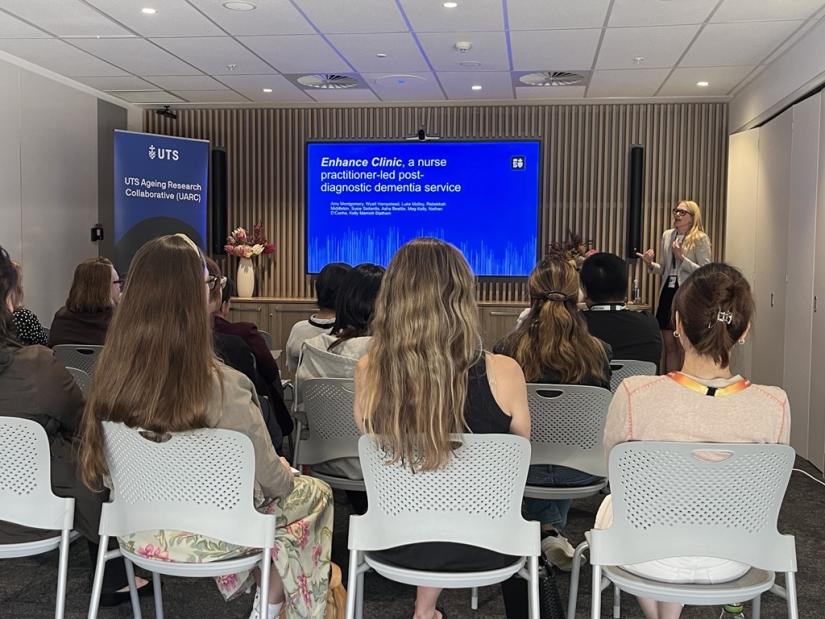
Dr Amy Montgomery shared how this question has shaped her journey from clinical practice to developing and testing new models of community-based care.
Speaking at the UTS Ageing Research Collaborative (UARC) seminar series, Amy shared her journey as a nurse practitioner and clinician researcher, beginning with an experience observing a geriatrician clinic. She saw first-hand the uncertainty people could face following a dementia diagnosis, particularly when it came to knowing where to find ongoing support.
“You could see the absolute fear in their eyes when they were told, ‘come back in six months’,” she said. “You could tell they absolutely had no idea where to go, and what to do, and who to ask for help.”
That experience inspired Enhance, a nurse practitioner led post diagnostic dementia clinic established at the University of Wollongong. The clinic brought together exercise, cognitive stimulation, yoga, mental health support and individualised activities, with care shaped around each participant’s goals, interests and needs.
“We didn’t force anyone to do anything,” Amy said. “If someone wanted to paint one week and they didn’t want to paint the next, and they wanted to do Lego, it was completely fluid to what that person wanted to do.”
While quantitative measures showed little statistically significant change, qualitative research captured outcomes that were harder to measure.
“Our participants really said that they had this sense of feeling truly known, respected, and connected.”
Amy shared that the research team also observed greater social engagement alongside changes in communication and physical function.
Our participants really said that they had this sense of feeling truly known, respected, and connected.
“We were observing these people come to the clinic every week who started to speak more fluently, who had less difficulty word finding, who developed strength, who were having less falls, who were just coming out of their shells more and more socially engaged.”
Amy has since helped explore how these principles can work across different settings, including adapting the SPICE dementia rehabilitation model within a residential aged care organisation and researching Active Mindsteps, a community program combining cognitive and physical activities.
Her current work is extending these lessons to older people with cancer through a community-based intervention focused on delirium education and prevention. The feasibility study is also exploring a more person-centred approach to data collection, allowing participants to prioritise the outcomes that matter most to them.
“It’s really kind of helped me to stop and reflect about what data we collect and how we collect that data for people living with dementia, to actually show that these programs have a really positive impact on their life, even though we can’t change the dementia underlying disease process.”
Across these projects Amy highlighted that meaningful healthcare research is built not only on interventions and evidence, but also on strong relationships with clinicians, communities and partner organisations.
“My advice is having face to face meetings and a coffee, particularly if you’re trying to engage with nurses,” she said. “They also want to know that you continue to show up, you continue to check in.”
It’s really kind of helped me to stop and reflect about what data we collect and how we collect that data for people living with dementia, to actually show that these programs have a really positive impact on their life, even though we can’t change the dementia underlying disease process.
For researchers beginning their own journeys, her final message was one of persistence.
“When you’re first starting out in your career, two years seems like a really long time, but in hindsight, it goes really, really quickly,” she said. “These things do take time.”
Amy encouraged participants to get in touch via email if they want to learn more.
What’s next?
- Attend the next seminar in the UARC Seminar Series on 1pm – 2pm, Wednesday 25 November. Registration details to come.