Congratulations to Catherine McElhone for being recognised with the Research Management and Development Award (Professional Staff) in this year’s Vice-Chancellor’s Awards for Research Excellence.
Championing research impact at UTS

Caption
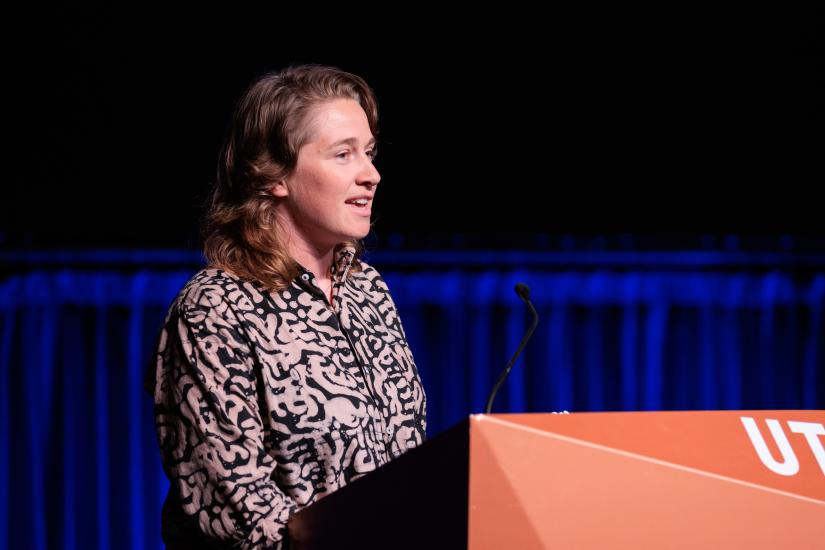
Research Impact Facilitator Catherine McElhone and Deputy Vice-Chancellor (Research) Prof Kate McGrath
Catherine’s contributions exemplify the critical role professional staff play in research excellence - enabling, connecting and amplifying the work of researchers - while strengthening UTS’s culture of collaboration, inclusion and innovation.
“Winning this award has been a wonderful encouragement, particularly at a time when many of us are working in conditions of uncertainty and change. It has been affirming to have work that is often behind the scenes recognised and valued,” said Catherine, who first joined UTS nine years ago after several years working in a start-up in California.
“I had returned to Australia to undertake postgraduate studies in Information and Knowledge Management. During that time my professors, Bhuva Narayan and Maureen Henninger, recommended me for a part-time, short-term role working with Scott McWhirter in research outputs verification in the central Research Office,” Catherine explained.
This became her entry to a career in research management.
Winning this award has been a wonderful encouragement, particularly at a time when many of us are working in conditions of uncertainty and change. It has been affirming to have work that is often behind the scenes recognised and valued.
“Over time, I developed a greater understanding of the research ecosystem and the critical role research impact plays,” said Catherine, who has made an outstanding contribution to UTS by strengthening how research impact is understood, supported and embedded across the university.
Communicating the value of academic research
In her current role, Catherine supports researchers and research teams with research impact planning, communication and evaluation.
“I work alongside researchers to help them make sense of the societal benefits of their work, whether that’s through impact narratives, case studies, engagement planning, or embedding impact thinking into systems and workflows.”
Through initiatives such as Distilling Research Impact, Catherine enables researchers to articulate and evidence the societal, policy and community value of their work, producing a body of high-quality impact case studies used to support funding, awards and external engagement.
I work alongside researchers to help them make sense of the societal benefits of their work, whether that’s through impact narratives, case studies, engagement planning, or embedding impact thinking into systems and workflows.
Catherine has also embedded impact into institutional systems and workflows, contributing to the implementation, design and effective use of platforms including Discovery Profiles, Symplectic Records of Impact and Figshare.
Alongside systems work, she delivers targeted researcher development and impact planning support for researchers across UTS disciplines.

Research impact leadership
Catherine’s community building initiatives, including introducing the UTS Icebreaker app, have strengthened collaboration among research support staff.
One of the most fulfilling aspects of Catherine’s work has been building relationships, both within UTS and across the research sector. Connecting with colleagues who care about research and social justice has been key.
Through her sector leadership with the Australasian Research Management Society and professional networks, she represents UTS as a leader in research impact practice.
Deciding to apply for this award gave me an opportunity to reflect on my own professional impact and the communities I’m part of.
“Being part of the Australasian Research Management Society has been particularly valuable for me to meet like-minded people, learn, share practice and contribute to something larger than my individual role or institution,” Catherine said.
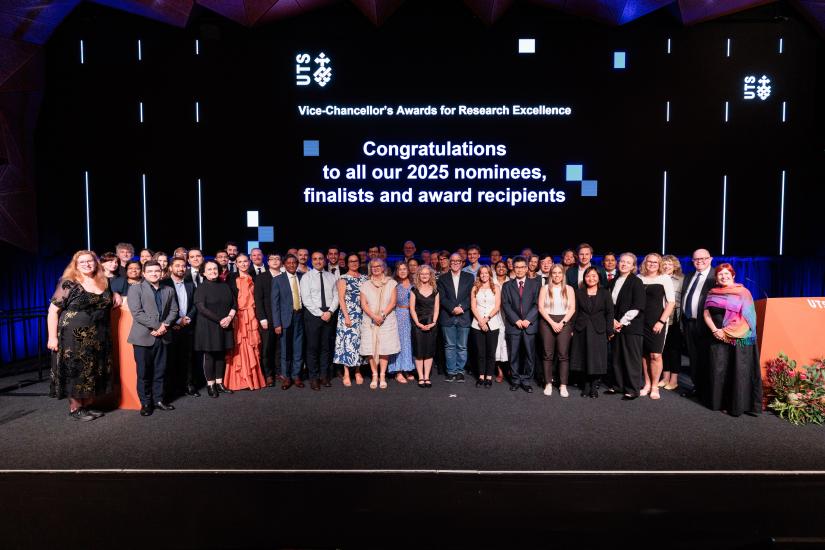
She encourages all those working in research roles to make the effort to nominate a colleague or themselves for the Vice-Chancellor’s Awards for Research Excellence.
“Deciding to apply for this award gave me an opportunity to reflect on my own professional impact and the communities I’m part of,” Catherine said. “Reflection isn’t something we prioritise often, but it’s incredibly valuable to take the time to acknowledge work that might otherwise go unnoticed.”