After nearly three decades in software engineering, Professor Asif Gill has witnessed the industry evolve from early Internet applications to today's AI-powered intelligent applications and development tools. While AI technology has dramatically accelerated software code production, he believes the future of software engineering lies beyond simply generating code.
Designing and building intelligent systems that augment human thinking

Caption
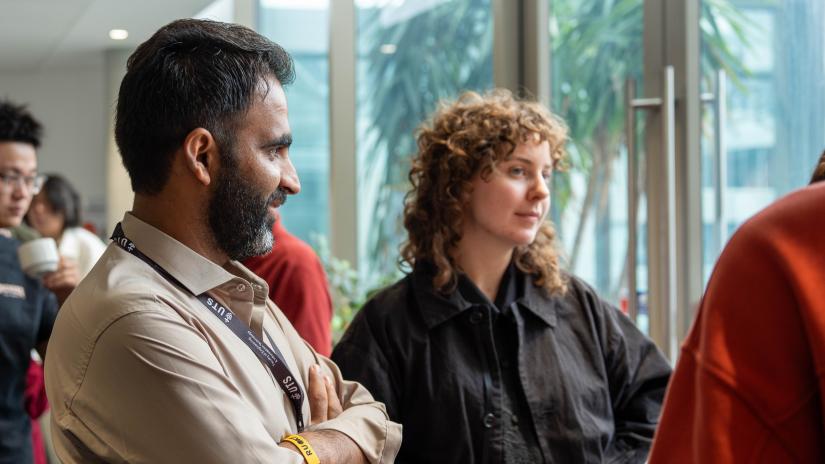
Prof Asif Gill speaking at Research Cafe
"Back in the day, speed was the challenge," he explained. "Today, speed is not the issue, and we can produce code very quickly. The real focus is returning to strong architecture and engineering practices."
Despite speculation that AI could replace software engineers, Asif believes that although coding is getting easier, software engineering, architecture, design, testing and human judgment remain critical.
“Our work is all about designing intelligent systems. We're exploring a human-centric approach to architecting intelligent AI systems. Our focus is not to replace humans. It's about augmentation, beyond automation.”
Asif leads research into intelligent systems that place people at the centre of the design process. His group explores how AI can augment human capabilities instead of removing humans from the design and engineering process.
Our work is all about designing intelligent systems. We're exploring a human-centric approach to architecting intelligent AI systems. Our focus is not to replace humans. It's about augmentation, beyond automation.
The team is working on an “architecture copilot”, a system designed to automatically generate enterprise architecture artifacts, a task that traditionally takes architects months to complete. The research combines applied industry partnerships with fundamental research in scalable enterprise systems, balancing real world impact with long-term innovation.
Asif’s research also explores what he describes as an "intelligence architecture" built around concepts such as perception, thinking and action.
“Just as different people can interpret the same information in different ways, AI systems can also develop different perceptions of the same data. That’s perception. Then there's thinking, and how we think about thinking via meta cognition. That's what we do in our modern intelligent software systems architecture as well. We explore how humans think and how we can simulate and augment their thinking and the software component.”
This research examines how such systems can better replicate and augment human reasoning through advanced human-AI systems architectures and metacognition.
The team is also developing tools and techniques for observable and trustworthy agent-based software engineering and legacy system transformation. Having worked across industries including banking, government, small businesses and healthcare, Asif understands the challenges organisations face as they modernise ageing technology systems, architecture and SDLC while embracing emerging AI capabilities.
As AI continues to reshape the technology landscape, Asif remains focused on ensuring that intelligent systems are designed for both efficiency and meaningful collaboration between humans and machines.