Addressing complex social challenges requires more than technical expertise. It demands a deeper understanding of people, behaviours and systems.
Driving social impact through research

Caption
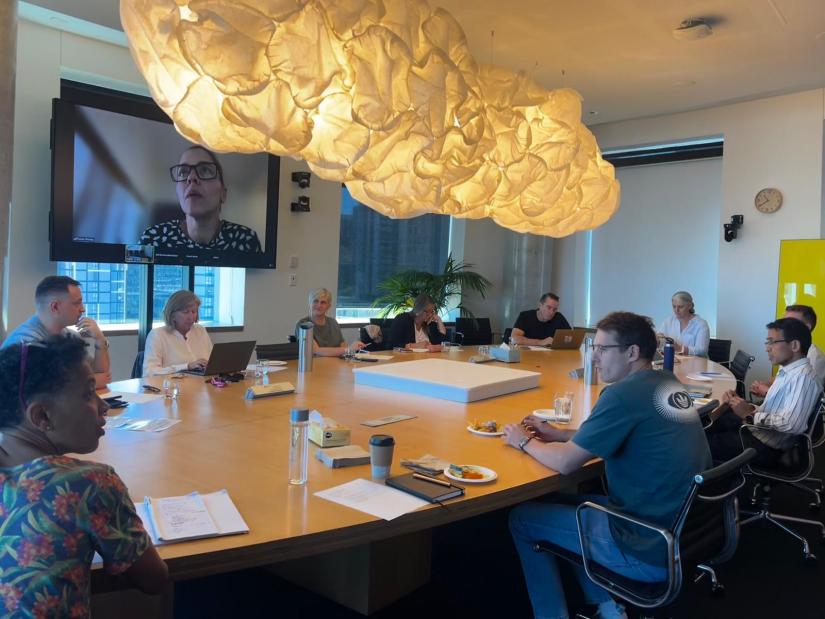
Change for Good at UTS team members (left to right): Dr Lewis Whales, Professor David Waller, Professor Ross Gordon, Dr Amir Armanious, Dr Scott Dwyer and Rao Natasha Ali.
Across the UTS Business School, researchers are taking a transdisciplinary approach to tackle issues such as public health, workplace inequality and social inclusion.
By combining insights from across disciplines and working closely with communities, their work focuses on driving behaviour and social change, shaping policies and delivering practical solutions that create lasting impact.
Addressing major social issues through transdisciplinary behavioural and social change: Prof Ross Gordon
When seeking to address the issues affecting society, we tend to look to scientists and technical engineers for the solutions. The end-users of these solutions are often left out of the planning process.
To design more inclusive solutions, Ross is taking a transdisciplinary approach to address some of society’s most pressing issues such as energy efficiency, gambling harm, climate change and public health.
“I have worked with scientists and engineers in the past who have admitted they can design, engineer and build a solution, but they don't always understand people and their behaviours. If you build an energy efficient building but humans don't want to use it in the way it was designed, then you've got a problem.”
If you build an energy efficient building but humans don't want to use it in the way it was designed, then you've got a problem.
As the Director of the Change for Good Centre at the UTS Business School, Ross and his team address complex problems through transdisciplinary behaviour and social change research. Their strategic, participatory and multi-level approaches help progress positive behaviour and social change, from supporting Australia’s adoption of electric vehicles, tackling childhood obesity, addressing violence against women, to combating gambling harm.
- Learn more about Change for Good at UTS.
- Learn more about Ross’ research.
- Read ‘Learning the Hard Way’ research impact case study.
- Read ‘Australian Consumers at the Heart of the EV Transition’ research impact case study.
Influencing change in public behaviour and public policy through the UTS Behavioural Lab: A/Prof Adrian Camilleri
The idea of a carbon footprint is widely understood, but how much does awareness of our environmental impact influence our choices? And does it make you think twice before selecting red meat off the supermarket shelf?
Adrian and colleagues at the UTS Behavioural Lab are exploring what influences decision-making and how we can develop strategies to encourage people to adopt better behaviours, from consuming more sustainable diets to reducing carbon footprints generated at the grocery store.
“The Behavioural Lab brings together researchers from diverse fields such as economics, marketing, management and finance with the common goal of understanding how people make judgments and decisions. We take that knowledge and apply it to societal issues with the goal of improving both people's decisions and public policy.”
Fighting worker exploitation and modern slavery in Australia: Prof David Bedford
You may not expect to find modern slavery in Australia. However, the cleaning industry, which employs over 120,000 people, is one of the most vulnerable and exploited sectors in the labour market according to David who is a Professor of Accounting.
“Modern slavery includes underpayment of wages, being subject to unsafe and dangerous working conditions as well as a lack of entitlements such as withholding superannuation payments. I've been looking at different ways in which accounting can be used to attempt to redress labour exploitation.”
By exploring ways to use accounting to improve working standards in the cleaning industry, David has created a pricing tool for better transparency in contract negotiations, with the goal of ensuring employees are paid the wages and entitlements they deserve.
UTS Centre for Indigenous People and Work: Prof Nareen Young
We can’t talk about flourishing careers or increasing leadership and management positions for Indigenous people until we address the fundamental issue of racism in Australia.
The Centre creates the opportunity for Indigenous people to own the narrative about our participation in the Australian workplace.
Nareen and colleagues at the Centre for Indigenous People and Work are giving Indigenous Australians a say in their workforce participation by providing a platform for creating policy.
“The Centre creates the opportunity for Indigenous people to own the narrative about our participation in the Australian workplace.”
UTS Disability Research Network: Emeritus Prof Simon Darcy AM
The UTS Disability Research Network focuses on working with, not for, people with disability through codesign, coproduction, transdisciplinary strategies and taking a whole-of-university collaborative approach.
“Together with like-minded individuals at UTS, we went through a design thinking, co-designed approach to establish an entity that is truly representative of UTS’ competitive advantages in the disability engagement and space. We want to work with people with disability so that lived experiences, which are central to understanding these issues, shape what our research agenda is, and together with those disability service and advocacy organisations that represent them to create transformative solutions.”