Congratulations to Diana Marshall, Niina Matthews and Nirmani Chathurya Dasanayake, three UTS PhD researchers selected among thirteen finalists in the FameLab Australia 2026 science communication competition.
FameLab finalists nail their stories

Caption
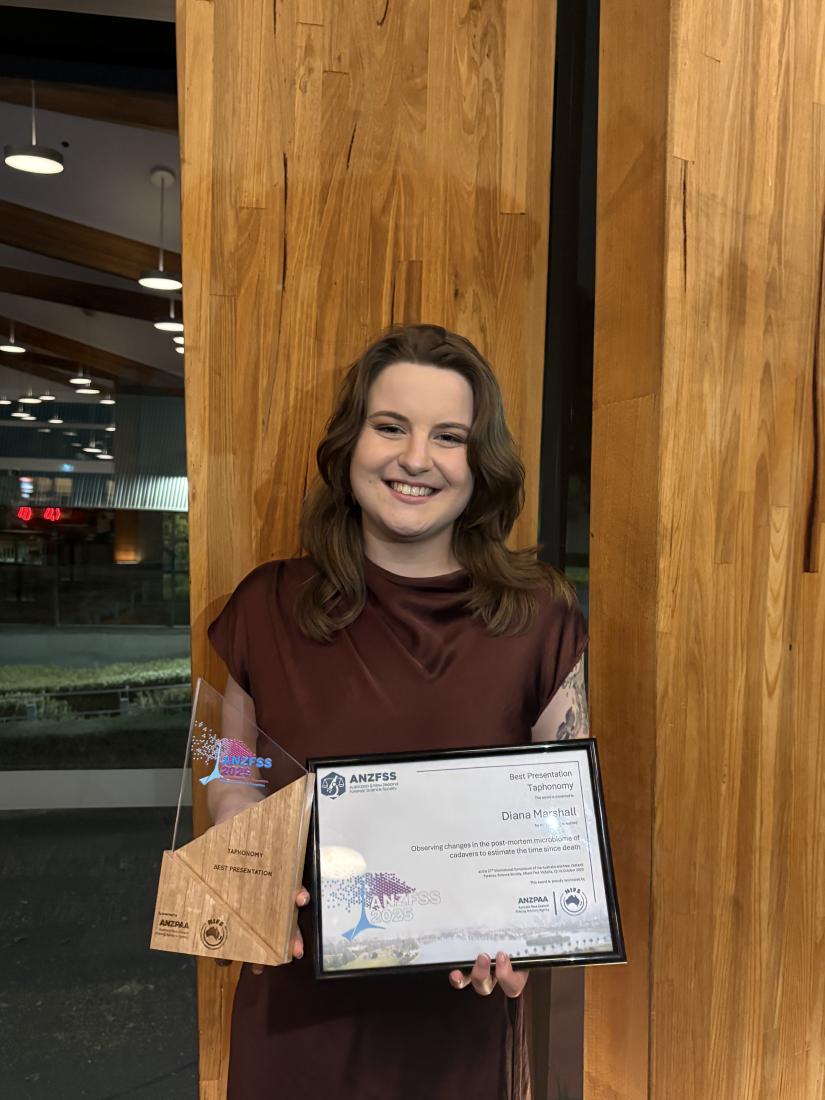
Diana Marshall with bug
With research interests spanning forensic microbiology, 3D bioprinting for heart failure treatment and digital transformation in healthcare supply chains, their FameLab experiences have helped them transform research into stories that people can relate to.
Having participated in online workshops, the three finalists will attend an in-person workshop in Perth ahead of the national final at the Western Australian Museum.
Along the way, they’ve learned to sharpen their stories, use props with purpose, think carefully about their audiences and embrace the three-minute format as a powerful platform for research communication.
Taking the plunge
The idea of entering FameLab began with curiosity and a little hesitation for Nirmani. Having followed a previous UTS competitor on LinkedIn, she made a note to consider applying for the competition the following year.
With a background at the intersection of business and technology, Nirmani nearly talked herself out of submitting the application, facing “very severe imposter syndrome, mostly about not being a ‘lab scientist’”. Eventually she recorded and submitted an entry video just 30 minutes before the deadline, thinking, “I have nothing to lose”.
Diana came enthusiastically to FameLab knowing it was a fantastic chance to share research she cares deeply about with people beyond her discipline.
“I was also following my supervisor’s advice to say ‘yes’ to every opportunity as a PhD researcher,” she explained, adding that she truly believes she has some really interesting research to share, and, as a PhD researcher, now is the time to try everything on offer.
“I’m exceptionally passionate about my research. I really love talking and connecting with people about it, not just other forensic scientists, but anyone that’s willing to listen!”
I was also following my supervisor’s advice to say ‘yes’ to every opportunity as a PhD researcher.
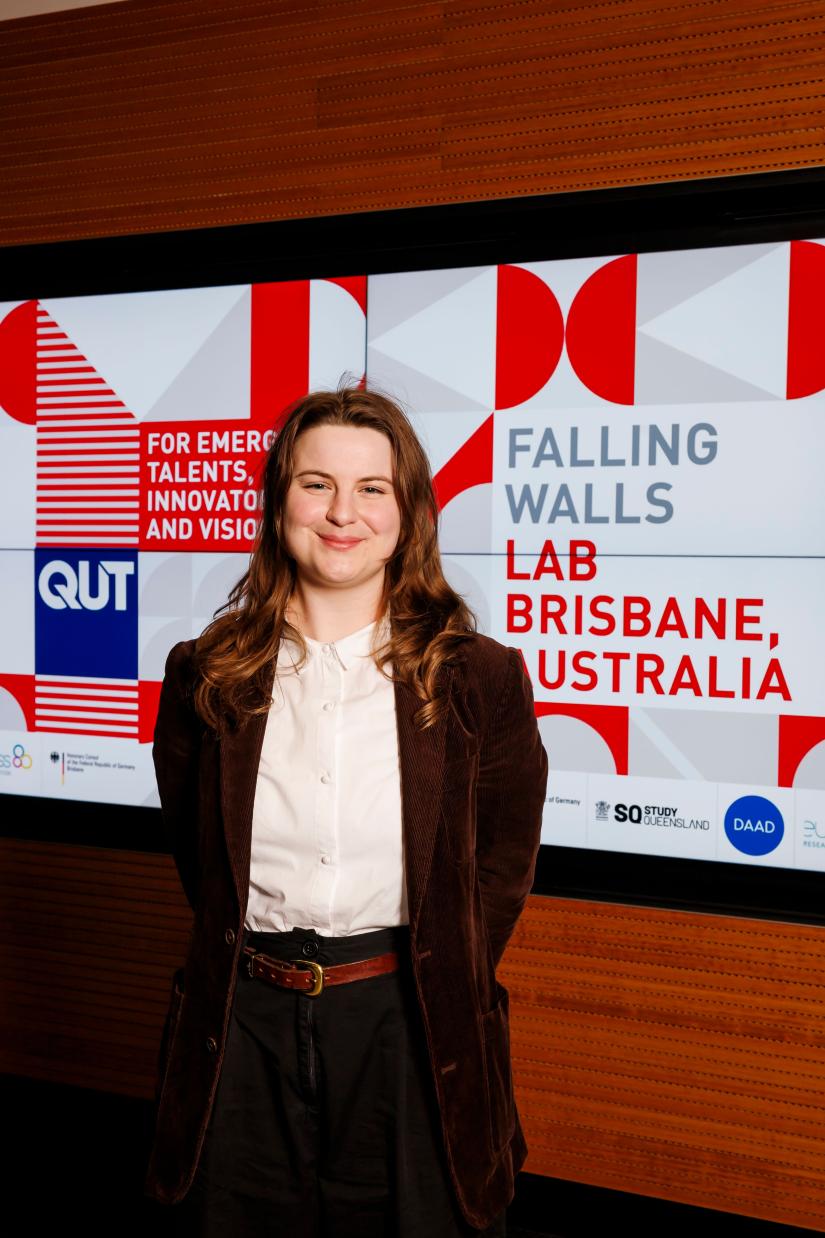
Having recently been awarded third place in another science communication competition, Falling Walls Lab, Diana continues to refine her research story.
A biomedical engineer, Niina was encouraged to enter by UTS microbiologist Dr Claire Richards, a previous FameLab runner-up.
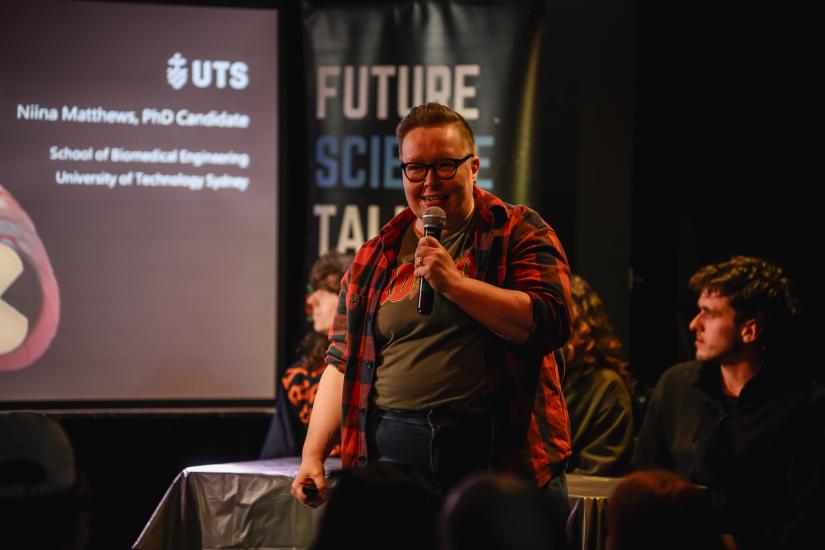
Niina has already delivered a wide range of public engagement, from participating in the 3-Minute Thesis competition and the Future Science Talks comedy program to giving conference presentations and facilitating panel discussions.
“FameLab gave me the opportunity to try something new. Compared to my PhD research presentation, I am developing a lighter, more playful take on my research, using a prop and comedic approach, as comedy has become one of my tools,” Niina said, adding that she has watched stand-up comedy all her life.
“I love comedy and bring humour very naturally to everything I do when I present.”
Finalists agreed that one of the biggest learnings from the FameLab experience is the value of storytelling.
“FameLab reinforces that a research talk needs more than a sequence of facts,” explained Diana.
“In order to talk to someone about your research who isn’t in the academic world, you need to create an engaging story that they can follow.”
FameLab gave me the opportunity to try something new. Compared to my PhD research presentation, I am developing a lighter, more playful take on my research, using a prop and comedic approach, as comedy has become one of my tools.
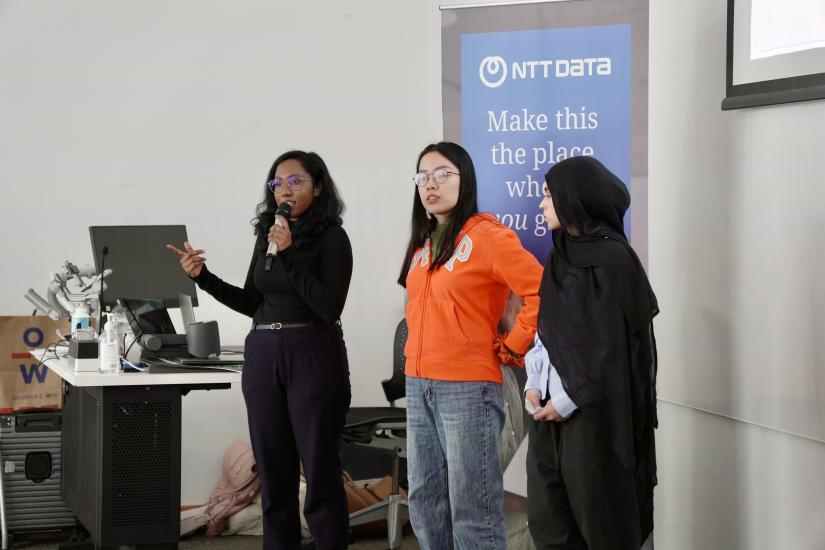
For Nirmani, whose research involves data standards, supply chains and digital transformation, she quickly realised she needed to find a way to communicate concepts that can become abstract. Feedback during the FameLab training helped her realise that terms that might be commonly used in research settings can be barriers.
“In a breakout room, another FameLab participant told me they did not understand what I meant by “digital transformation”. This feedback helped me create a more accessible story around connections, strategy and practical change,” she said.
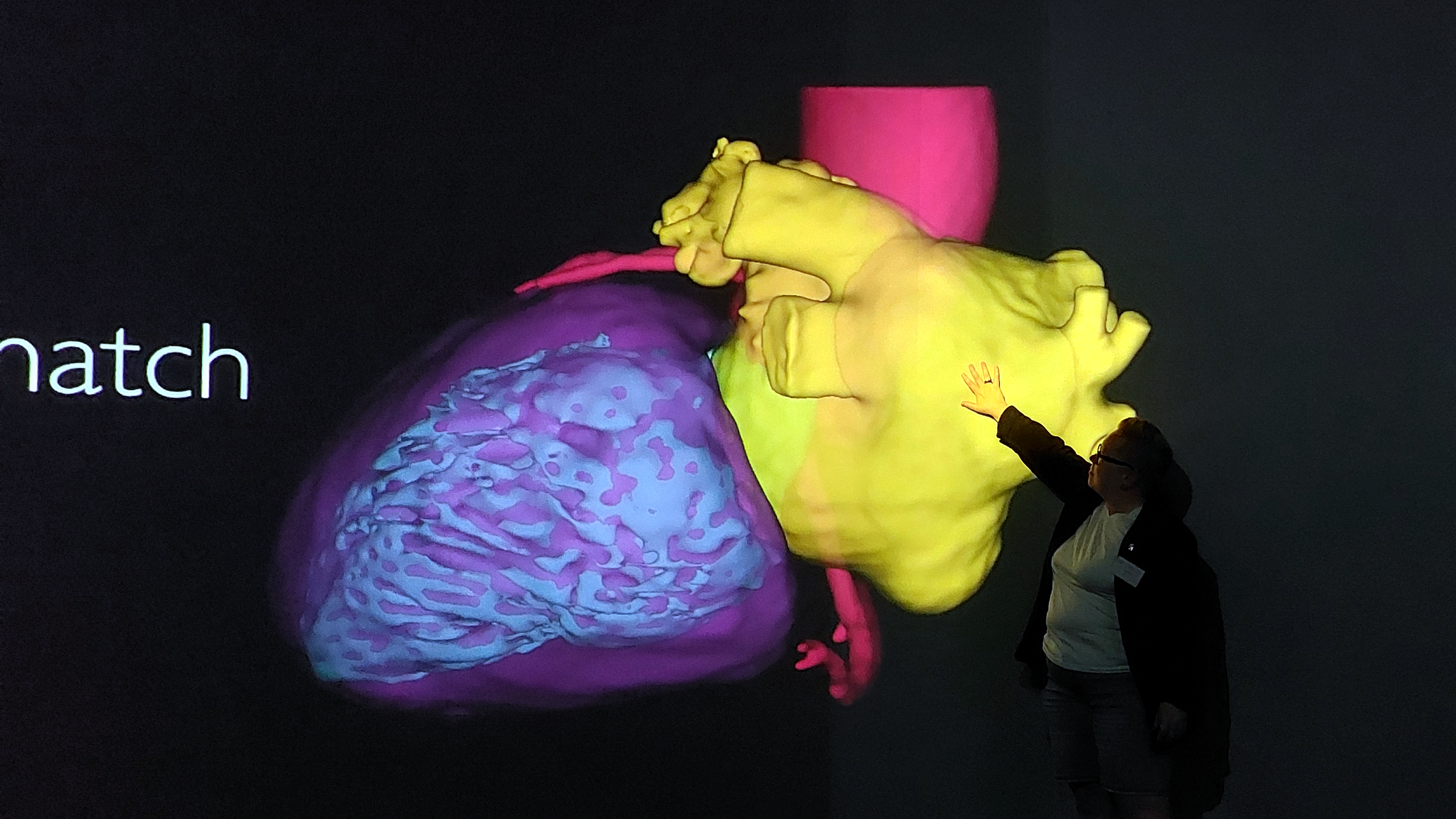
Niina agreed and said you need to ensure your research story is relatable. Her work creating 3D bioprinted cardiac patches might be technically complex, but she describes it simply as creating a “bandaid for fixing broken hearts”.
Rising to the 3-minute challenge
Being able to communicate powerfully within three-minutes without slides has been another learning opportunity that has helped the finalists distil their work into a punchy story.
“You’re not going to be able to deliver a full rundown about your research in three minutes, but you can definitely convey what it is about in a meaningful way,” Diana said.
Niina agreed, adding that “everyone should have an elevator pitch of their work”.
The final countdown
As the national final approaches, each finalist is refining a different part of their performance.
Niina will focus on practising with her prop until it feels natural to use it on stage.
Nirmani is working through her nerves, deciding how to use her prop and introduce early research insights into her story.
Diana is polishing her performance line by line, while being careful not to over-rehearse.
“When you’ve only got three minutes, quite literally every sentence matters, and needs to have a bit of a punch,” she said.
Their advice to other researchers is to start small, take every opportunity on offer to hone your storytelling skills and keep building your research story.
“Just go for it. Ask yourself, what have you got to lose? Most of the time, it’s not a lot,” Diana said. “You don’t get into the FameLab finals without having done and potentially failed a bunch of the smaller things.”
“Don’t wait until you feel completely ready,” added Nirmani who applied 30 minutes before the deadline. “That one bold step opened a door I didn’t think was for me.”
Just go for it. Ask yourself, what have you got to lose? Most of the time, it’s not a lot.
Niina’s message is: “Just do it! We’re not special. FameLab is open to everyone! We’re regular PhD students doing research and taking the opportunities that come our way. If it doesn’t land, it doesn’t land. No matter the outcome, you’ll still find a new way to make people want to know more about your work and why it’s important.”
Meet the UTS finalists
- A PhD candidate in forensic microbiology, Diana’s research examines the postmortem microbiome, sometimes referred to as the necrobiome. She is investigating how bacteria in the mouth of decomposing human cadavers changes over time, with the aim of identifying microbial patterns that could help forensic investigators estimate the postmortem interval, or time since death, more accurately. See more at Diana’s UTS Discovery Profile.
- A PhD researcher in the School of Electrical, Mechanical and Biomedical Engineering, Niina is responding to major challenge in cardiovascular medicine: donor hearts are limited, transplantation is complex and many patients need alternatives that can support repair or regeneration. Niina investigates how 3D bioprinting can be used to create patient-specific cardiac patches for people with heart failure. See more at Niina’s UTS Discovery Profile and in this feature article The heart un-breakers.
- A researcher in information systems in the School of Civil, Environmental and Sociotechnical Engineering in the Faculty of Engineering and Information Technology, Nirmani’s research focuses on digital transformation and how information technology can be applied in practical business settings, with a particular interest in supply chain management and healthcare supply chains. See more at Nirmani’s UTS Discovery Profile.
About FameLab
Created by Cheltenham Festivals in the United Kingdom, FameLab is the world’s leading science communication competition. Since launching in 2007, it has expanded to more than 40 countries and welcomed over 40,000 scientists worldwide.
FameLab offers a focused platform to learn how to communicate effectively, skills Diana says are “very, very valuable, whether we stay in academia or not.”
Watch the finals
Join the 13 finalists on stage in Perth as they compete for the title of FameLab Australia 2026 Champion. The winner representing Australia will travel to the United Kingdom to participate in the FameLab International Final in front of a global audience!
When: 6 pm Thursday 24 September
Where: Western Australian Museum
Watch the livestream at https://perthvideo.net/famelab-2026.