Dr Kumar Biswajit Debnath, Professor Nimish Biloria from the UTS School of Architecture and Built Environment, and A/Prof Cuong Ton-That from the UTS School of Mathematical and Physical Sciences have secured a place in the top 3 ClimateLaunchpad Australia and top 8 ClimateLaunchpad Asia-Pacific (APAC) 2026 for their invention that uses biomass waste from industry and construction to create bio-based material, earning a spot at the global pitch event in Singapore.
Transforming waste into bio-based materials

Caption
Left to right: A/Prof Cuong Ton-That, Dr Kumar Biswajit Debnath and Professor Nimish Biloria
As a Chancellor's Research Fellow at the School of Architecture, Kumar is transforming the future of construction through pioneering interdisciplinary approaches to sustainable building materials.
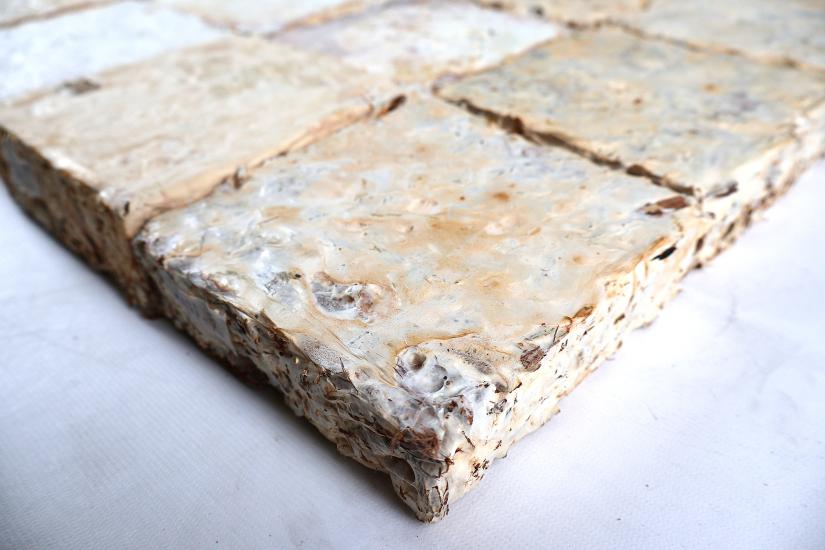
By upcycling organic waste and utilising innovative mycelium-based composites, Kumar and his team are creating climate-resilient, bio-based materials for use in architecture and construction that address the challenges of a warming world.
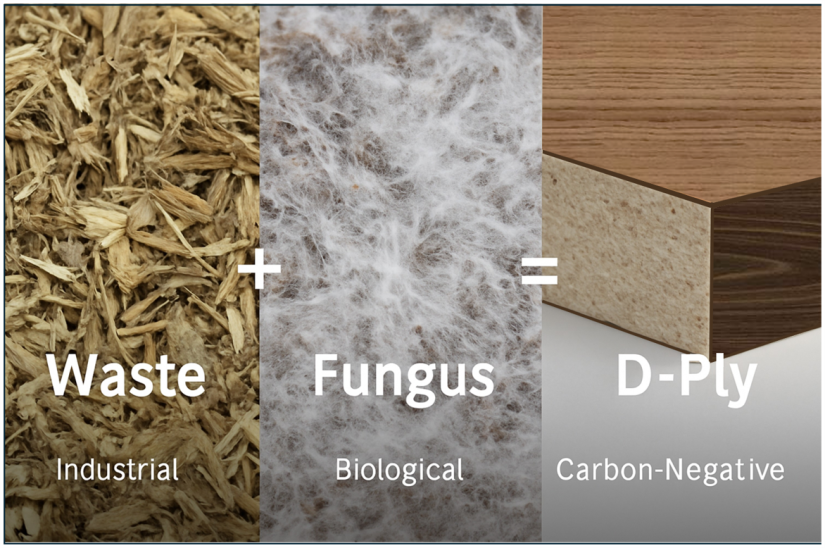
Their product, D-Ply, is commercialising a novel engineered wood material that does not contain any resin nor emit toxic volatile organic compounds (VOCs).
D-Ply utilises Australian microorganisms and industrial, agricultural and construction biomass waste to produce engineered wooden boards, combining waste (industrial) and fungus (biological) to create the D-Ply (carbon-negative).
“Our competitive edge is the biological part that is living and completely biodegradable,” Kumar said.
“Our product offers strength, lighter weight as well as fire, thermal and acoustic insulation. At the end of its life, it is fully biodegradable and compostable and, overall, a carbon-negative material.”
Our competitive edge is the biological part that is living and completely biodegradable.
Turning research into market ready solutions
In 2025, Kumar and his team were finalists in the UTS Research Translation Competition for their pitch D-Ply, where they gained invaluable insights into the commercialisation process.
“The Research Translation Competition was a great learning event for our team. It was a great opportunity for us to learn how to navigate the commercialisation route from research. We learnt so much!” he said.
“It was eye-opening to see how to look at a research innovation from the consumer's and market's perspective. We will incorporate these learnings into our current and future research initiatives.”
Kumar encouraged other researchers to join future rounds of the competition to discover how to translate their research ideas into impact.
It was eye-opening to see how to look at a research innovation from the consumer's and market's perspective.
Kumar suggested future participants communicate with the Research Translation team from day one as they go about finding a potential innovation to pitch.
“They should also start talking to relevant industry partners with the support of the Research Translation team before going into the competition, as this will help them to understand the customer demand and shape their commercialisation plan.”
Advancing to the global stage
ClimateLaunchpad is the world’s largest green business ideas and cleantech competition, operating in more than 50 countries and supporting early-stage climate innovations. In Australia, the program is delivered by Climate-KIC Australia at the UTS Institute for Sustainable Futures in partnership with EnergyLab and Boomerang Labs.
The program is free for successful applicants, takes no equity in participating ventures, and participants retain full ownership of their ideas.
"ClimateLaunchpad is an annual global program that connects innovators with an international network of start-ups, mentors and acceleration pathways," said Sina Lengelsen-Brown from Climate-KIC Australia.
"We invite all UTS staff, students and researchers to put forward innovative climate solutions across renewable energy and energy storage, circular economy and sustainable materials, water and ocean solutions, food and agriculture, sustainable buildings and infrastructure, transport and mobility, climate adaptation and resilience, and other innovations that have the potential to deliver meaningful climate impact. The next Australian cohort is planned for 2027 and we encourage anyone with an early-stage climate innovation to get involved."
"Taking our mycelium-based composite research from the wet labs at UTS and translating it into a scalable business model in front of judges from across the Asia-Pacific has been both humbling and exhilarating. The boot camps and mentoring pushed us to rigorously test our value proposition, customer discovery, and impact metrics,” Kumar said.
“It transformed how we view D-Ply, not just as a scientific breakthrough, but as a viable, investable solution for the built environment."
After progressing through national boot camps, mentoring and webinars, Kumar and his D-Ply team were selected as one of Australia’s top three climate innovations. Competing against 40 start-ups and innovators from 12 countries across the Asia-Pacific region, the team secured a place in the APAC Top 8. They will now be sponsored to represent Australia in Singapore in September, with the opportunity to progress to the global ClimateLaunchpad Grand Final.
"Our ultimate ambition is to disrupt the construction and furniture industries by offering a true drop-in replacement for traditional engineered wood, one that uses zero toxic glue, zero virgin wood, and actively sequesters carbon.”
“We want to turn Australia's agricultural and industrial biomass waste into a high-performance resource, proving that 'growing' our building materials is not just a lab curiosity, but a scalable pathway to a circular bioeconomy."
Our ultimate ambition is to disrupt the construction and furniture industries by offering a true drop-in replacement for traditional engineered wood, one that uses zero toxic glue, zero virgin wood, and actively sequesters carbon.