Quantum technologies are expected to change how we protect information, detect tiny changes in the body or the environment and solve problems that are too complex for today’s computers. But there’s a major barrier. Quantum systems are incredibly difficult to build outside the lab.
Building Australian capability in quantum hardware
Image

Many rely on fragile experimental setups, carefully aligned beams of light, specialist materials or extremely cold conditions. Researchers can prove what’s possible, but struggle to translate this knowledge into reliable devices that can be manufactured and used by others.
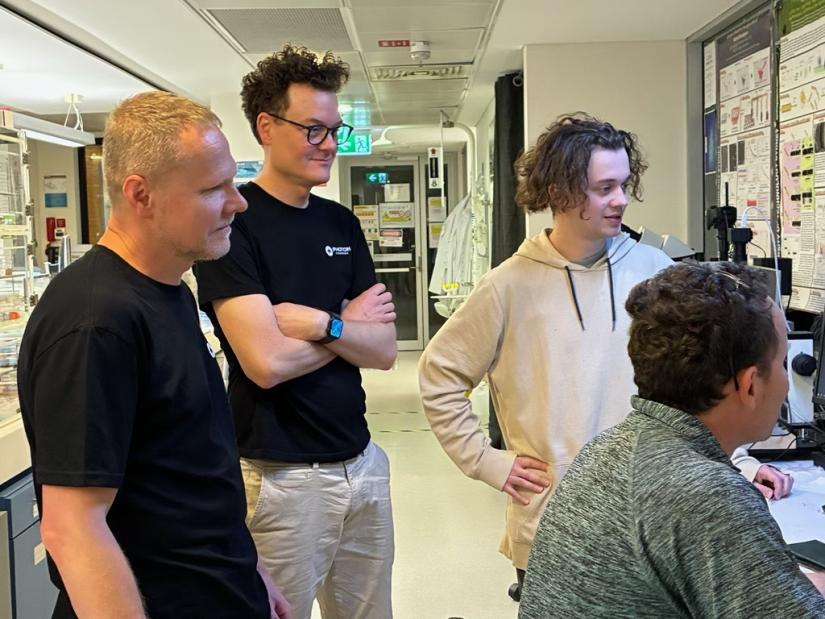
Built on more than a decade of research at UTS, Photon Foundry is an early-stage UTS spin-out working to turn advanced quantum-light research into practical hardware that can be used beyond specialist laboratories.
As current computing systems approach their limits, quantum technologies are set to enable new capabilities across healthcare, communications, security and manufacturing.
Co-founder and CEO Dr Byron Villis said that while practical quantum computing is still years away, quantum systems will need to be connected by light.
“Light is the fastest and most efficient way to transport information over long distances,” he explained. “The smallest particle of light is called a photon, and these photons will form the building blocks of future quantum networks.”
Founded on ten years’ research at UTS, Photon Foundry is bringing quantum light out of the lab and into hardware people can build with.
“Ten years ago, UTS researchers produced single photons on demand from a flake of boron nitride at room temperature. At the time, nobody had done that before,” said Byron.
The spin-out translation model
“Turning a scientific breakthrough into a technology people can use takes more than great research. You need the right support to bridge the gap between discovery and application,” said Co-founder and CSO and Professor Igor Aharonovich from the UTS School of Mathematical and Physical Sciences.
As a company backed by UTS under its Research to Impact program, the team has access to commercialisation support as well as facilities and a strong talent pipeline to enhance their deep expertise in quantum light, advanced materials and nanoscale fabrication.
Turning a scientific breakthrough into a technology people can use takes more than great research. You need the right support to bridge the gap between discovery and application.
“For researchers like me, it's exciting to contribute to real-world applications. It's an opportunity to apply my research skills to building technologies that have genuine impact in the world,” said Research Fellow Ben Whitefield.
A staged commercialisation approach
The team’s current focus is on product development, manufacturing samples for research users and developing packaged devices that can connect more easily to existing light-based systems.
“This model allows research and translation to happen side by side: the company develops technology while the science continues to power ahead,” said Igor.
"Our staged commercialisation approach helps reduce both technical and investment risk. We supply single-photon samples to customers, their feedback guides future development,” added Co-founder and CTO and Professor Milos Toth, also from the UTS School of Mathematical and Physical Sciences.
This model allows research and translation to happen side by side: the company develops technology while the science continues to power ahead.
From there, the team develops quantum components. Over time, this work could support packaged light-source devices that are easy to use and could be built into future products for secure communication, sensitive measurement and future quantum technologies.
“Rather than waiting for a future quantum computing market to emerge, we are creating value today while building towards our longer-term vision,” said Milos.
UTS support
For research to make a difference, it must connect with the people and partners who can apply it, use it, adapt it and scale it. As an early-stage company, Photon Foundry works closely with UTS researchers to turn quantum-light discoveries into practical hardware while progressing commercial readiness, industry engagement, IP and equity arrangements as well as future investment pathways.
The project also leverages research capability from the ARC Centre of Excellence for Transformative Meta-Optical Systems (where Milos is the Chief Investigator) which supports the technical development behind Photon Foundry’s single-photon emitter platform.
What’s next?
- Discover Photon Foundry.
- Discover the UTS Research to Impact (R2I) program.
- Explore your pathway to impact at RES Hub.