The construction industry makes up between 7-9% of GDP and employs 1.2 million workers. The industry is one of the most challenged sectors of the economy, facing workforce shortages, productivity pressures, safety risks and an urgent need to reduce environmental impact.
Building human-robot collaboration

Caption
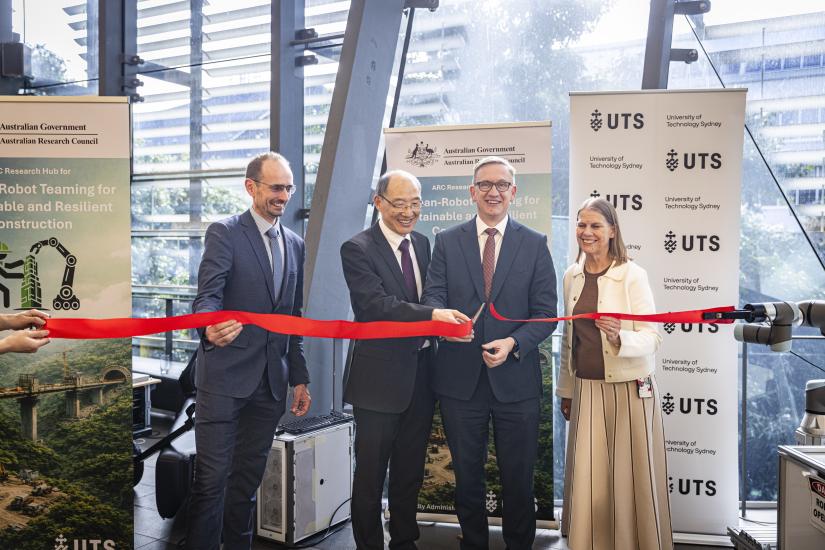
Distinguished Professor Dikai Liu at the launch of Human-Robot Teaming for Sustainable and Resilient Construction (HaRTCon)
To address these issues, Australian Research Council (ARC) Industrial Transformation Research Hub for Human-Robot Teaming for Sustainable and Resilient Construction (HaRTCon) has been established to boost productivity and improve health and safety in the construction industry by advancing intelligent robotic technologies that foster seamless collaboration between people and robots.
The $23 million transdisciplinary research collaboration brings together seven partner universities, fifteen construction companies, industry bodies and government agencies to explore the use of human-centred intelligent robots in infrastructure.
With research teams working across fields such as robotics, AI, construction safety, social technical systems, human factors, economics and social psychology, HaRTCon is important on a national level.
Speaking at the launch, Dean of the UTS Faculty of Engineering & Information Technology Professor Peta Wyeth said that addressing the significant challenges faced in construction requires new thinking and new technologies.
We’re incredibly proud at UTS to be leading this hub and to be joined by partners from across Australia to progress this important research.
“This is exactly what HaRTCon has been established to deliver. It's through the vision of Distinguished Professor Dikai Liu and his collaborators that we have brought together key experts, leading researchers, industry partners and government organisations to develop human centred robotics that improve safety, productivity and support sustainability across the construction sector.”
Peta said that UTS is deeply committed to research that translates into real world impact and outcomes.
“Our approach is always to work closely with our industry and community partners to understand their goals and challenges. We’re incredibly proud at UTS to be leading this hub and to be joined by partners from across Australia to progress this important research.”
Reimagining human-robot cooperation
Commonwealth Assistant Minister for International Education, the Hon Julian Hill MP added that this critical research partnership will offer new ways of bringing together robotics technology with the construction workforce.
“I'm a big supporter of the collaborative approach seen here through universities partnering and taking a human centred approach to designing technologies that support people at work, improving safety and wellbeing and ultimately enabling more productive, sustainable and inclusive workplaces.”
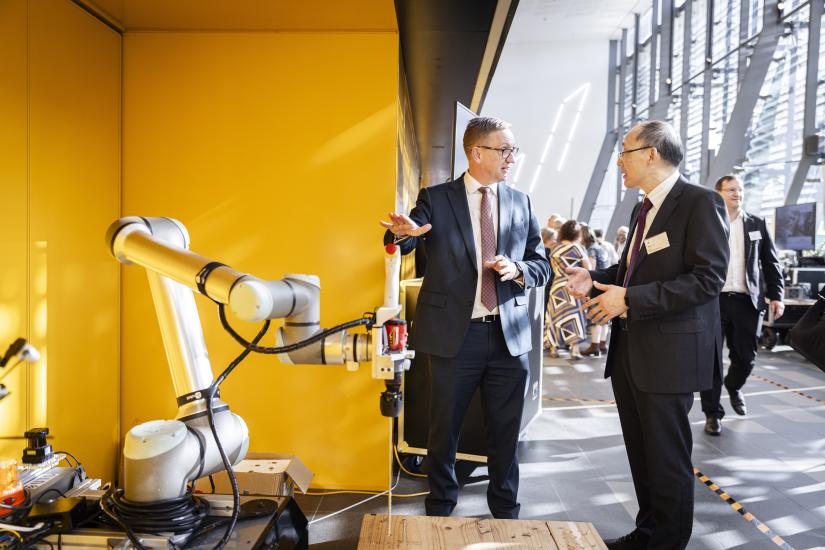
HaRTCon is led by Director Distinguished Professor Dikai Liu, a world renown robotics expert. He said the challenges faced by the construction sector in Australia and the world cannot be solved by technology alone.
“We must rethink how humans and robots work together. Human-robot teaming is an emerging field that focuses on combining human judgement, creativity and adaptability with robotic precision, power and consistency. It has immense potential to address some of these issues in the industry.”
What’s great about HaRTCon is its human-centred approach and pivotal role in transforming the economy and building trust in robotic systems.
With a mission to develop human robotic technologies and systems that can transform work practices, improve health and safety and create a more sustainable and inclusive workforce, the team’s vision is to advance human-centric intelligent robotics technologies that foster seamless collaboration between humans and robots.
Guided by the pillars of technology, people, business and quality, Dikai said that HaRTCon is committed to transdisciplinary collaboration.
“This will ensure the human dimension and needs of end users remain at the heart of all research projects,” he said.
Dikai acknowledged HaRTCon’s partners for their trust and willingness to innovate.
“I want to acknowledge the incredible hub teams, our researchers, engineers, students and UTS professional staff, whose passion and hard work have helped us transform the hub's mission into a reality.”
“We look forward to working together with all of you over the years to shape the future of construction through developing responsible and human centred robotics.”
ARC Deputy Chief Executive Officer, Anthony Murfett, affirmed his agency’s commitment to partnerships across sectors.
“What’s great about HaRTCon is its human-centred approach and pivotal role in transforming the economy and building trust in robotic systems,” Anthony said.
NSW Chief Scientist and Engineer Professor Hugh Durrant-Whyte, one of Australia's leading experts in robotics, autonomous systems and artificial intelligence, said that HaRTCon is at the cutting edge of research.
“We cannot operate the way we have been with robotics. You've got to build models of things, and you've got to work in different ways. You've got to really build new types of research and new types of activity. That’s what this centre is doing.”