Distinguished Professor of intelligent robotics Dikai Liu joined the UTS Research Café to explain how he is developing robotics for use in the construction industry, one of the most challenged sectors of the economy.
Building with human–robot teams

Facing continuing workforce shortages, productivity pressures, safety risks and an urgent need to reduce environmental impact, the construction industry employs 1.2 million workers. Their safety can be greatly improved by using human-robot teaming.
“Challenges faced in the construction industry include productivity, skills shortages, health and safety, as well as managing waste and environmental impacts,” Dikai explained. “Our solution is to have humans and robots working together to combine their respective strengths.”
Our solution is to have humans and robots working together to combine their respective strengths.
While humans are good at conceptualising, making decisions and handling uncertainty, Dikai said robots are very good at working with speed, power, consistency and endurance.
“In some areas, they can perform even better than humans.”
As Director of the Australian Research Council (ARC) Industrial Transformation Research Hub for Human-Robot Teaming for Sustainable and Resilient Construction (HaRTCon), Dikai and his team are developing intelligent robotic technologies that foster collaboration between people and robots.
“Our projects investigate how humans and robots can work together in coexistence, cooperation or physical collaboration,” Dikai said, adding that HaRTCon is committed to transdisciplinary collaboration to ensure the human dimension and needs of end users remain at the heart of all research projects.
“Technology alone is not enough to address how we can responsibly introduce robots into construction. We also look at the human and social aspects of technical systems, exploring psychology and human behaviour as well as what would be the appropriate business models.”
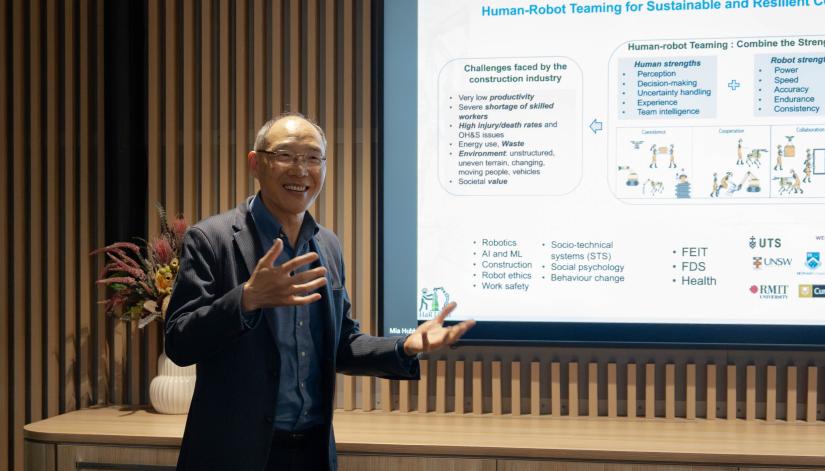
Across fourteen cross-disciplinary research programs, three UTS faculties, seven universities and fifteen industry partners, HaRTCon team members have expertise in robotics, AI, social technical systems, psychology, behaviour change, ethics and safety.
Dikai said that in the years to come, responsible and human centred robotic technologies can be used to transform work practices, improve health and safety and create a more sustainable and inclusive workforce.