Mona Forghani is a Sydney-based artist whose handmade collages explore narrative, nostalgia, and visual play. As an artist and lawyer, Mona was invited to create a collage in response to one of the central arguments in Prof Ramona Vijeyarasa’s book, Rewriting the Rules.
If it is broke, fix it

Rewriting the Rules: Gender-Responsive Lawmaking for the Twenty-First Century examines how the legal system, despite its origins within structures built by and for men, still holds unrealised potential for advancing gender equality.
“Rather than abandoning the law as inherently incapable of serving women, Prof Vijeyarasa urges us to imagine how legislation might meaningfully change if it were rewritten to reflect the everyday experiences of women,” Mona said.
Her collage entitled If it is broke, fix it (2025) is an attempt to visualise this invitation and to look again at the legal system not as a monolith, but as a structure capable of transformation from within.
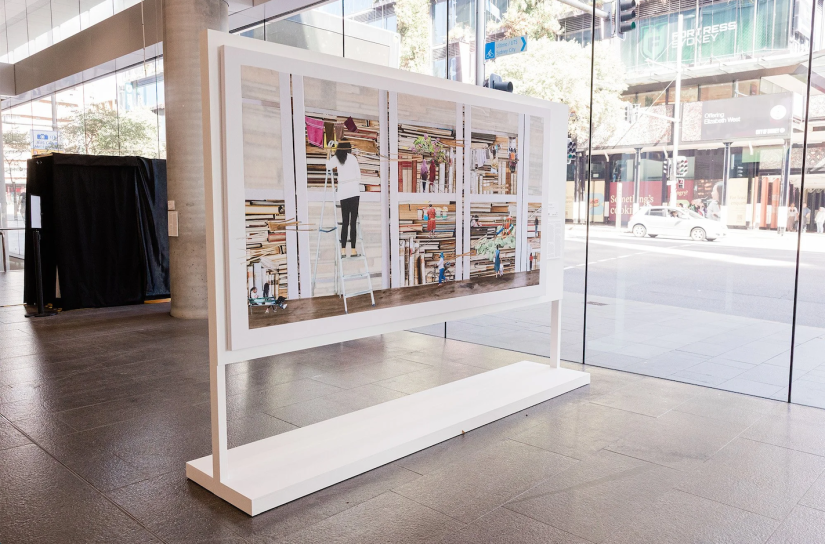
This artwork is now on display in RES Hub where the UTS research community can reflect on the power of creative approaches to research translation, as explained by Ramona in the Research Café.
Mona spoke to the RES Hub team about her experiences of creating this work.
How did you start to respond visually to the ideas in Rewriting the Rules?
Coming up with the design for the collage was an iterative and collaborative process with Ramona, though from the outset it was grounded in the metaphor of a bookshelf. When I first read Chapters 1 and 2 of Rewriting the Rules, the chapters I was tasked with visually representing, I immediately thought of the shelves in my university law library from my time as a law student.
The image of towering bookshelves lined with imposing volumes, their prestigious covers concealing pages of dense legal jargon, came to mind. These were books that could only be read within the library, reinforcing their sense of authority and exclusivity. This imagery seemed to parallel one of the central arguments Ramona explores in these chapters: that our legal system, historically shaped by white, middle-class men, often fails to reflect or respond to the lived realities of many people in our society, particularly women.
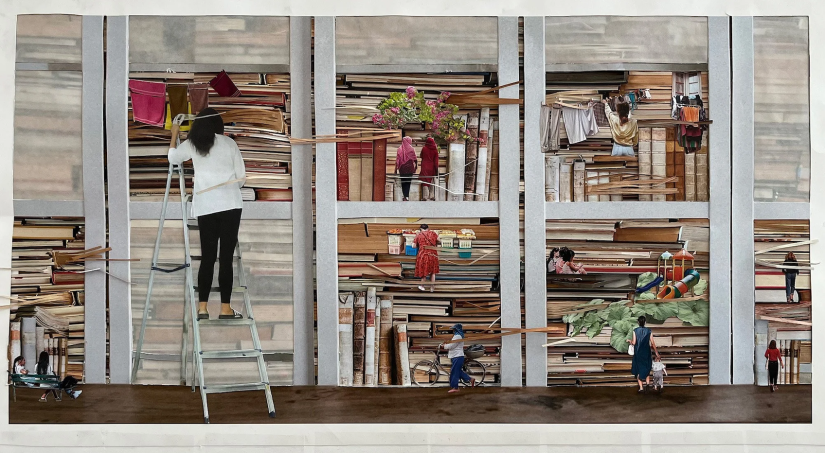
Through a series of conversations with Ramona and my own experimentation with different design concepts, we gradually developed this bookshelf metaphor into a visual representation that more fully captured the themes and ideas explored in these chapters.
Why does the background feature an image of books that shows their pages and not their spines as you would typically see on a bookshelf?
I thought the image of the books lying horizontally was an effective way of conveying the idea that the law needs to be turned "on its head", not through a complete overhaul, but through meaningful and substantial reform to make it more gender-responsive, as Ramona argues.
Positioning the books horizontally also made them appear less imposing and more approachable, reinforcing the idea that creating a more gender-responsive legal system is not an unattainable ideal, but something within our collective reach.
How do the domestic scenes disrupt traditional ideas about what the law values or regulates?
Western legal systems have traditionally maintained a distinction between the public and private spheres, treating the latter as largely beyond the law's concern. Yet it is often within the private sphere that women experience some of the most pervasive forms of injustice and insecurity: domestic violence, unpaid labour, and the disproportionate burden of domestic and caregiving responsibilities, to name just a few.
The inclusion of domestic scenes in the collage therefore serves to symbolically invite the law into this historically neglected domain, challenging the assumption that these experiences lie beyond its reach.
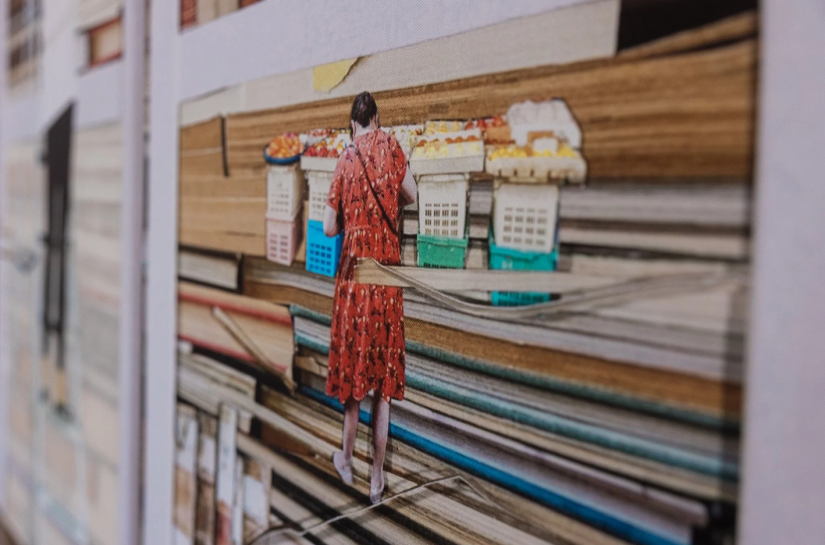
At first glance, these domestic scenes may appear irrelevant or even out of place. Viewers may question why something as ordinary as a woman buying produce at the local market, taking her child to the playground, or hanging out the laundry should warrant the attention of lawmakers. Yet it is precisely this assumption that the collage seeks to challenge.
By foregrounding these everyday moments, the work invites viewers to recognise that the seemingly mundane routines of domestic life are shaped by legal structures and laws and are therefore deserving of legal attention.
The woman on the ladder feels central. Who does she represent?
The inclusion of the ladder was one of Ramona's excellent suggestions. It evokes the familiar setting of a legal library, where ladders are used to reach books housed on the highest shelves, while also symbolising the law's capacity to enhance the everyday lives of women. In searching for the right image, I came across the image in question, a woman standing on a ladder, and immediately felt it captured this idea perfectly.
She is dressed simply, wearing everyday clothes and slippers, yet stands confidently and purposefully on the ladder. She represents the ordinary woman—while acknowledging, of course, that there is no single, homogeneous category of "woman." She is not necessarily someone with years of higher education, a position within the political sphere, or a privileged social background. Instead, she symbolises the women whose lived experiences have too often been overlooked by the legal system. Her presence on the ladder reflects the need for the law not only to take those experiences seriously, but also to invite the women who live them into the process of legal reform.
If viewers take away one idea from this work, what do you hope it is?
At the heart of the collage is one of Ramona's central arguments: that although our legal system has its origins in structures built by and for men, it still holds significant, unrealised potential to advance gender equality. The collage seeks to convey that creating a more gender-responsive legal system does not require dismantling the law altogether. Rather, it calls for thoughtful and meaningful revision, reworking existing legal frameworks so that they better reflect and respond to the lived realities of women.
At the heart of the collage is one of Ramona's central arguments: that although our legal system has its origins in structures built by and for men, it still holds significant, unrealised potential to advance gender equality.
This idea is expressed visually through the coexistence of preservation and transformation. The upright books and sections of the bookshelf enclosed behind glass symbolise the enduring foundations of the legal system, while the unravelled pages that weave through scenes of domestic life represent the process of rewriting the law to incorporate experiences and forms of labour that have long been overlooked.
What’s next?
- Read Mona’s statement about this artwork.
- Learn more about Mona Forghani.
- Discover the exhibition, Rewriting the Rules.
- Receive a calendar invitation to the fortnightly Research Café.