For most people, the ability to speak is something taken for granted. But for those who stutter, communication is an ongoing and complex challenge.
Providing support for people who stutter

Caption
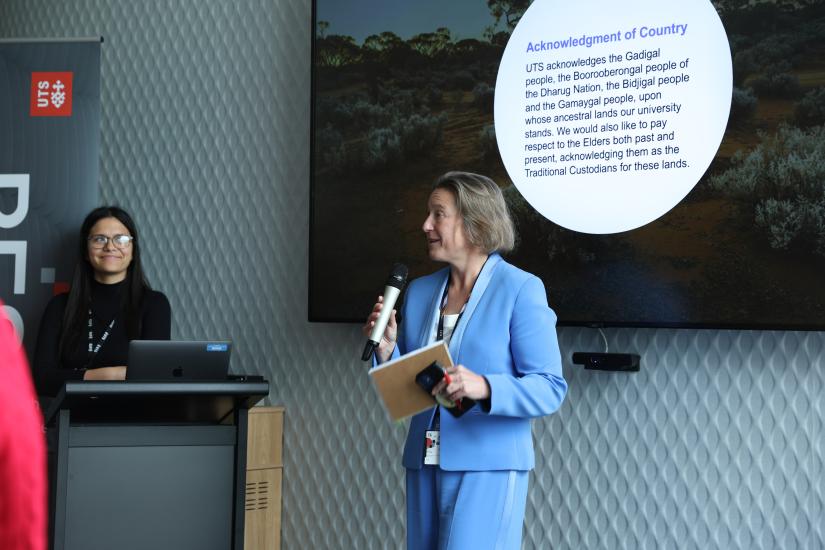
Associate Professor Robyn Lowe speaking at Research Cafe
Associate Professor Robyn Lowe, a speech pathologist at the UTS Australian Stuttering Research Centre, joined us in the Research Cafe to share how stuttering can have significant impacts across the lifespan, particularly on mental health.
“Social Anxiety Disorder is a condition that many who stutter experience,” Robyn explained, highlighting the broader emotional and psychological consequences of the condition.
Stuttering typically begins in early childhood, emerging during the critical period of language development.
Outcomes are strongest when support is delivered early, that means for young children as soon after onset as possible.
While effective treatments for children exist for speech and associated anxiety, access to timely intervention is a global challenge.
Social Anxiety Disorder is a condition that many who stutter experience.
Redressing the service shortfall with free online support
Stuttering affects a substantial proportion of people, with 10% of the population stuttering at some point in their lives. This creates significant demand for support services, placing pressure on already limited speech pathology resources.
“A significant problem we face is that there aren't enough speech pathologists to be able to treat the number of children who stutter globally,” Robyn said.
Barriers such as cost, accessibility, and geographical location limit the ability of families to receive treatment, particularly in the early stages of stuttering when intervention is most effective.
In response, the Australian Stuttering Research Centre has been pioneering innovative, digitally delivered treatment programs. These are standalone online interventions that don’t require a speech pathologist or a psychologist. They have been designed for different age groups, from very young children through to adults.
A significant problem we face is that there aren't enough speech pathologists to be able to treat the number of children who stutter globally.
One of those programs focuses on early intervention by training parents to deliver treatment to their child at home. Another program is designed to treat the social anxiety commonly experienced by adults who stutter. This online treatment is now freely accessible worldwide and is available on the website of the Australian Stuttering Research Centre.
“Our anxiety treatment for adults who stutter has been available for 10 years. It is free to the world and has already serviced more than 2,700 people from 79 countries,” Robyn said. “Our estimates calculate that there's been a saving of around $5 million in healthcare costs.”
Expanding treatment options with technology
Looking ahead, Robyn and her team are exploring the integration of emerging technologies into these standalone treatments, such as artificial intelligence, machine learning, and natural language processing. These tools have the potential to further enhance accessibility and personalise treatment at scale, extending support to communities that have historically been under-serviced.
“Our goal is to continue to provide effective, cost-free and accessible treatments to people who stutter across the globe.”
Through a combination of clinical expertise, digital innovation and global collaboration, the work of the Australian Stuttering Research Centre is reshaping how stuttering is understood and treated, bringing equitable communication support to more people than ever before.
What’s next?
- Learn more about the Australian Stuttering Research Centre.
- Learn more about Robyn’s research.
- Join us at the next Research Cafe on 12pm - 1pm 20th May in FEIT (CB11.09.118).