After decades of pushing signals into digital form, is it now time to rethink the value of analogue processing? Dr Rasool Keshavarz from the Radio Frequency and Communication Technology Lab at UTS is challenging one of the core assumptions of modern electronics: that progress must always move further into the digital world.
Rethinking the future of signal processing

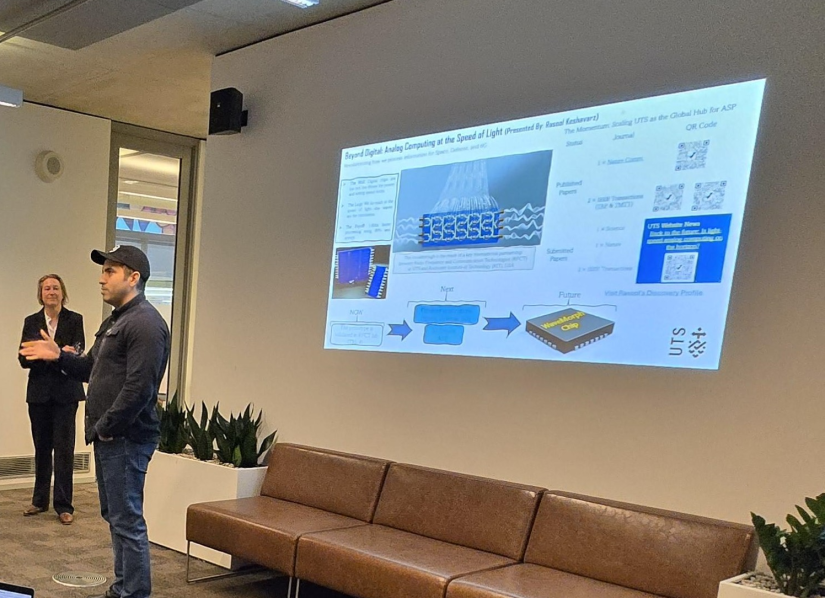
In a recent talk at Research Cafe, Rasool compared the history of art and the evolution of signal processing. Just as art moved from classical traditions to modernism and then back again through postmodernism, he argues that engineering is beginning a similar return.
Rasool explained how traditional digital signal processing requires real world analogue signals such as sound or radio waves to be converted into streams of zeros and ones.
“While this approach is powerful, it can also be slow and extremely power hungry, particularly for applications involving very high data rates. Emerging technologies such as 6G communications and remote sensing push these systems to their limits,” he said.
Rasool and his collaborators have taken a different approach. Inspired by the idea of stepping back and deconstructing established methods, his team has developed an analogue signal processor that keeps signals in their natural wave form from input to output.
“We have moved back towards analogue signal processing and have tried to deconstruct everything along the way, including by having analogue waves in the input and in the output,” Rasool said.
“By avoiding digital conversion altogether, processing can occur at close to the speed of light while using around ninety percent less power than comparable digital systems.”
Rasool’s work has already gained significant international attention, including through publication in Nature Communications, with further papers submitted to Science and other leading journals. The team has built and tested a working prototype at UTS and is now exploring applications in areas such as space technology, 6G networks and remote sensing.
Looking ahead, Rasool and his team aim to combine analogue processing with artificial intelligence, leading towards what Rasool calls a “WaveMorph chip”. This would be a chip scale, integrated analogue processor capable of operating far beyond current digital limitations.
“We have a prototype that we have tested and validated in the lab, and then we will move forward to different applications beyond digital limitations with hopes of achieving a WaveMorph chip soon,” Rasool said.
By avoiding digital conversion altogether, processing can occur at close to the speed of light while using around ninety percent less power than comparable digital systems.
The team’s project is a collaboration between UTS and RIT University in the United States and represents a bold reimaging of how future computing systems might work, not by moving forward into ever more complex digital systems, but by rediscovering and reworking the power of analogue waves.
Read more about Rasool's research:
- Programmable circuits for analog matrix computations - DOI: https://doi.org/10.1038/s41467-025-63486-z
- An Ultra-Compact Interdigital-Loaded Microstrip Lens Array for Beam Steering and Direction Finding - DOI: 10.1109/TAP.2026.3669189
- Real-Time Discrete Fractional Fourier Transform Using Metamaterial Coupled Lines Network - DOI: 10.1109/TMTT.2023.3278929
- Back to the future: Is light-speed analog computing on the horizon?
What’s next?
- Visit Rasool’s Discovery Profile.
- Reach out to Rasool via email to learn more.
- Attend the next Research Cafe on 20 May, 12pm – 1pm at CB11.09.118 and view previous Research Cafe slides.