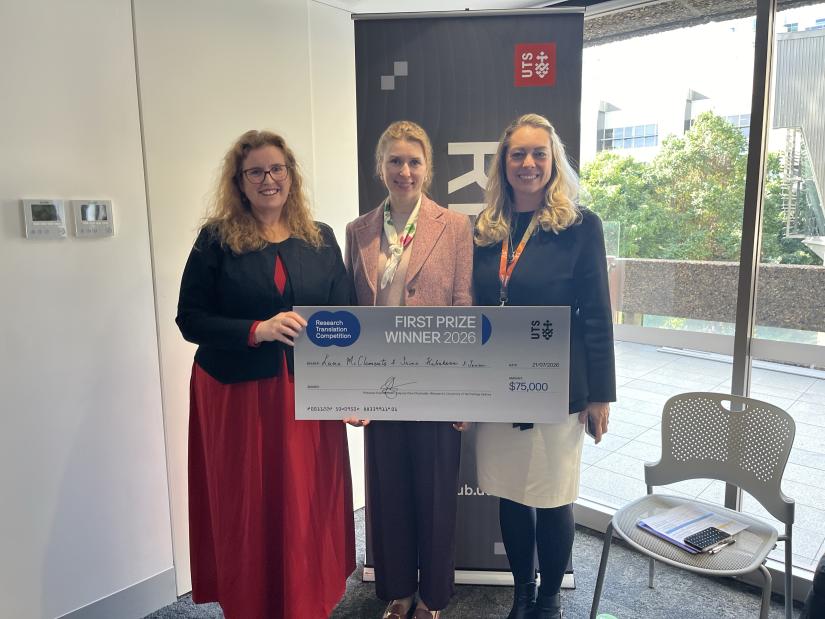
A UTS team developing a portable quantum imaging diagnostic system has won the 2026 UTS Research Translation Competition, securing $75,000 to help move its real-time diagnostic technology closer to clinical validation.
Quantum imaging team wins UTS Research Translation Competition

Caption
Left to right: Research Translation Manager, James Fraser, Commercialisation Manager, Dr Jude Amalraj, A/Prof Lana McClements, Prof Irina Kabakova
Waiting for pathology results can be one of the most anxious parts of a patient's journey. After a biopsy, surgery, cervical smear or colonoscopy, patients may wait days or even weeks before learning whether everything is okay.
Representing the winning team’s entry entitled ‘Q-Gnostics – Label-free Portable Quantum Imaging for Digital Pathology’, Associate Professor Lana McClements asked the judging panel to imagine a different experience: receiving reliable answers before leaving a clinician’s office.
“Have you ever had to have a skin biopsy, cervical smear or colonoscopy and waited for days, or even weeks to find out the results? Now imagine that before you even leave the doctor's office or imaging suite, you are told everything is okay. You're given your results. The worry disappears instantly and you walk out of the clinic with peace of mind,” Lana said.
Our device creates a faster path to cancer diagnosis and can be helpful in monitoring the treatment outcomes. It could be used in an operating theatre, for example, straight after a biopsy.
That vision is now a step closer. Working with Professor Irina Kabakova, Professor Alexander Solntsev and Dr Isa Ahmadalidokht, Lana is developing a quantum-based imaging device designed to make cancer diagnostics faster, cheaper and available in real time at the clinic.
From laboratory prototype to clinical potential
Irina said that the team is one of only a few groups in the world designing this kind of pathology system. Its initial focus will be on tissue imaging for cancer diagnostics, where the ability to see and analyse samples quickly could transform the way clinicians make decisions.
“Our device creates a faster path to cancer diagnosis and can be helpful in monitoring the treatment outcomes. It could be used in an operating theatre, for example, straight after a biopsy,” explained Lana.
Irina added that current processes can take days or even weeks for pathology labs and clinicians to get a result to the patient. The team believes its technology could offer a more affordable alternative to existing diagnostic imaging systems.
“Our technology is also much cheaper than present day diagnostics,” she said.
Next steps
With earlier support of $400,000 from the Critical Technology Challenge Program of the Department of Industry, Science, Energy and Resources, the team built its first-of-its-kind laboratory prototype.
Having won the UTS Research Translation Competition, the team will now invest prize money into the clinical validation process to refine the device, strengthen its value proposition and progress towards real-world testing.
Professor Kate McGrath, UTS Deputy Vice-Chancellor Research, congratulated the winning team for the clarity of its translation pathway and the potential to scale its technology beyond the immediate application.
“This team really impressed us,” she said. “There were very clear next steps so we could see the ability to scale this system beyond the specific prototype that team members are exploring at the moment.”
Reflecting on the Research Translation Competition in its sixth year, Kate said the calibre of this year’s pitches shows how strongly UTS’s research translation culture is developing.
There were very clear next steps so we could see the ability to scale this system beyond the specific prototype that team members are exploring at the moment.
“The average quality of what we’re seeing has massively changed over the past six years. This reflects our maturity across the university as well as the way we are understanding the capacity our research provides to explore translation and commercialisation opportunities.”
About the UTS Research Translation Competition
The UTS Research Translation Competition provides a pathway for novel research to be translated into impact. In 2026, selected teams participated in workshops covering IP basics, value propositions, business models and pitch preparation before presenting their translation plans at a final pitch event. The winning team and runner up each receive cash prizes to help realise their developed translation plans.
What’s next?
- Discover how UTS supports Research Translation as part of its Research Ecosystem.
- Discover Associate Professor Lana McClements’ research.
- Discover Professor Irina Kabakova’s research.
- Discover Professor Alexander Solntsev’s research.
- Discover Dr Isa Ahmadalidokht’s research.