Are you interested in contributing to space research? UTS recently hosted a Space Community Workshop over two days, bringing together academics and professional staff from across the university who are working in, or interested in contributing to, the space domain.
Shaping our future in space
Image

The Space Community Workshop marked the first time the UTS space community had been convened in this way, representing an important step towards building a more connected, visible and strategically aligned space research group at UTS. The workshop was intentionally repeated to maximise participation and ensure broad input from a growing and diverse community.
deep Sector Engagement and UTS 2030
The workshop opened with an overview of deep Sector Engagement (dSE) and its role in supporting the UTS 2030 Strategy by enabling coordinated, university-wide engagement in strategically important domains.
The Space and Defence dSE focus area was introduced within this broader framework, acknowledging that while space and defence are closely linked in Australia, they do not always require identical strategies.
Given the emerging nature of the UTS space community, the workshop placed a deliberate emphasis on space, while recognising the strong overlap with defence-related activity and the reality that much of Australia’s space ecosystem is currently defence-driven.
Participants were also introduced to the Space and Defence dSE team - when it was formed, its focus to date, and why it remains an open and growing community that welcomes broader involvement.
Reflecting on progress and building awareness
To ground the discussion, the workshop highlighted a range of UTS achievements and activities in space over the past year, many of which were eye-opening for participants encountering the breadth of UTS activity for the first time.
These included:
- UTS engagement at the International Astronautical Congress, including a UTS Space Welcome event, lab and delegate tour, sponsorship of early-career researchers, and showcasing student work
- ongoing efforts in capability mapping, helping surface the diverse research strengths, facilities, and partnerships already present across the university
- proactive communication of opportunities to the community, including MBRSC payload opportunities, national initiatives, and SRN-led grants and white papers.
These reflections reinforced the value of visibility, coordination, and shared awareness, themes that continued throughout the workshop.
Understanding the ecosystem and funding landscape
Participants were also provided with an overview of the Australian and international space ecosystem, recognising it as a small but rapidly growing sector with increasing opportunities. The funding landscape was discussed at a strategic level, including national schemes such as the Space Research Network (SRN), Australia’s Economic Accelerator (AEA), the Australian Research Council (ARC), Cooperative Research Centres Projects (CRC-Ps) and emerging (Cooperative Research Centres) CRCs and other international opportunities across the Asia-Pacific and Europe.
Rather than focusing on individual funding calls, this session aimed to provide context and perspective: where opportunities exist, how they are evolving, and how a coordinated approach could position UTS more effectively.
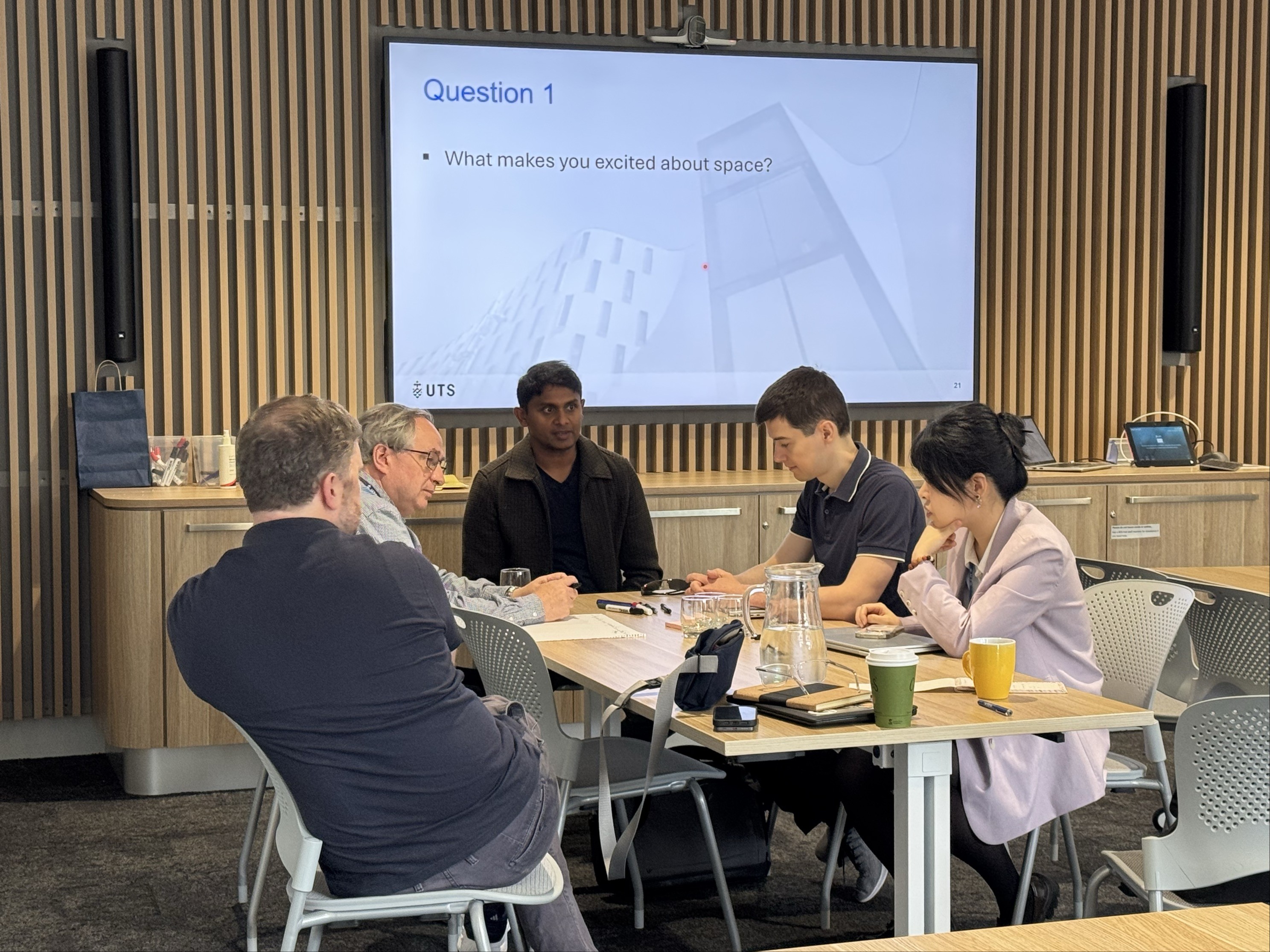
What excites the UTS space community?
The interactive component of the workshop began with a simple but powerful question:
“What excites you about space?”
Responses captured both the imagination and diversity of the community. Some participants described space as “the final frontier”, spoke of the excitement of discovering the unknown, and highlighted the motivation of doing hard things that have never been done before.
Others emphasised space as a uniquely multidisciplinary domain, enabling work that spans engineering, data, robotics, health, psychology, manufacturing, and sustainability.
There was strong enthusiasm for Moon and planetary exploration, human space biology and space colonies, new manufacturing technologies, and solving complex problems at the limits of human and technological capability. Many participants also highlighted the potential for space technologies to support humanitarian and climate-related challenges.
Together, these responses revealed a community motivated not only by technology, but by purpose, curiosity, and impact.
Participants identified strong existing capabilities across areas such as AI, robotics, data engineering, satellite sensing, human–technology interaction
Surfacing capabilities, challenges, and opportunities
Building on this shared energy, participants worked in mixed groups that deliberately combined academics and professional staff, space-experienced and space-new colleagues, and a range of career stages.
Groups reflected on:
- capabilities UTS already has that support space
- what UTS does well or differently compared to others
- challenges and constraints currently limiting growth
- opportunities that feel realistic in the next 3–5 years.
This structured, pre-SWOT approach helped establish a common understanding before moving into more formal strategic discussion.
Participants identified strong existing capabilities across areas such as AI, robotics, data engineering, satellite sensing, human–technology interaction and applied research operating at higher TRLs. UTS’s agility, industry engagement, applied focus, and distinctive facilities, including Tech Lab, simulation environments and specialist laboratories, were repeatedly highlighted as strengths.
At the same time, challenges were discussed candidly. These included siloed research activity, difficulty retaining talent, limited visibility of internal capabilities, workforce pipeline constraints, challenges accessing facilities and the absence of a clear national space strategy.
Looking ahead
Participants identified a set of realistic and strategically important opportunities over the next three to five years. A strong theme was the need to intentionally build a clear and recognisable UTS space brand, one that showcases UTS’s applied strengths, facilities, and partnerships, and signals that the university is ready to lead and coordinate large, multi-partner space initiatives, not just participate in them.
A key enabler of this ambition identified by the community was the opportunity for UTS to lead centre- or hub-based initiatives, such as training centres, capability hubs, or coordinated programs that bring together research, facilities, industry engagement and workforce development.
Mechanisms such as ARC Training Centres or similar models were seen as particularly important for addressing workforce pipeline challenges, increasing national visibility, and positioning UTS as a convenor and leader in the space domain.
There was also strong consensus that UTS should continue to invest in basic scientific research in space-related areas, even where immediate financial returns may not be evident. Sustained investment in foundational research was viewed as essential to positioning UTS as a leader beyond the next five years, enabling future breakthroughs, attracting top talent, and underpinning long-term partnerships and major funding opportunities.
Other opportunities identified included developing space-focused teaching offerings and micro-credentials, building flight heritage through payload opportunities, strengthening direct engagement with industry and government agencies, expanding international collaborations (including with organisations such as the European Space Agency (ESA) and Japan Aerospace Exploration Agency (AXA) and leveraging emerging trends such as AI–space convergence.
Together, these point to a strategy that balances long-term vision, capability development, workforce training, and near-term engagement.
What’s next?
The insights gathered across both days will now be synthesised to inform the ongoing development of UTS’s space strategy, refine internal capability mapping, and guide future engagement, funding, and collaboration activities.
Outcomes from the workshop will be shared back with the community, reinforcing that this is a co-created and evolving strategy. As the workshop made clear, this was not about finalising a strategy in isolation. It was about building a connected, visible, and ambitious space community at UTS, with the foundations in place to lead in the years ahead.
To support this next phase, a short questionnaire has been circulated to the current and emerging UTS space community.
- If you are not yet active in space projects but see potential relevance for your research, help the dSE Space group build a more detailed and accurate UTS space capability map by completing the survey.
- Participation is encouraged even if you are not currently working in the space domain.
- If your research could be relevant to space, or if you are interested in becoming involved in future space-related activities, your input is welcome and valued.
For more information and to get involved, contact Thomas Leoni, co-lead of the dSE for Space group.