How do you build a research program that is collaborative, sustainable and effective in changing clinical practice? Professor Meera Agar works in palliative, aged and chronic care, fields where the biggest questions are not always about cure, but about comfort, function, dignity and quality of life.
Building research programs that improve care

Caption
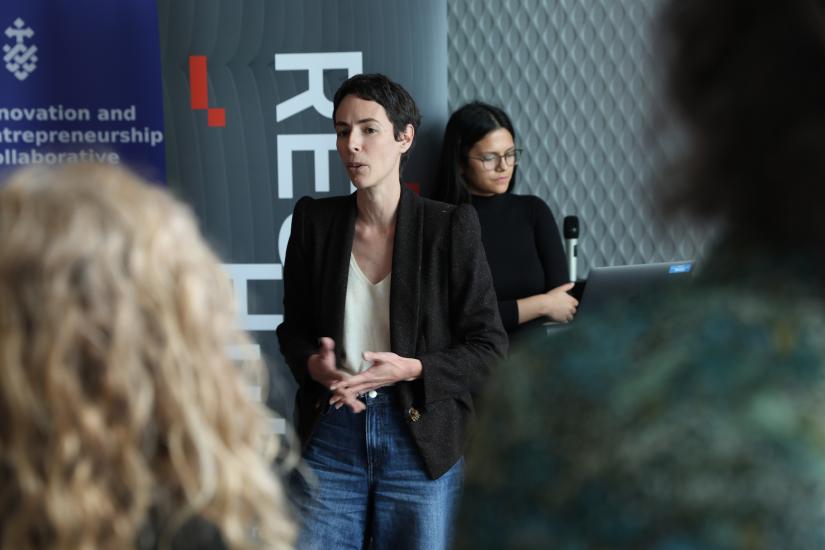
Professor Meera Agar speaking at Research Cafe
The Director of the Centre for Improving Palliative, Aged and Chronic Care through Clinical Research and Translation, Meera leads a co-designed research program that begins with a simple but powerful commitment: to improve care for people whose needs are often overlooked in mainstream health research.
Her team is driven by the vision to see every patient receive the best palliative, aged or chronic care at all times, no matter their life circumstance, their state of health or the place of residence.
“Our vision is ‘Best care, any place, every time for all patients receiving palliative, aged or chronic care.’ This shapes the questions we ask, the grants we pursue and the partnerships we build,” explained Meera. “It also means challenging old assumptions.”
Early in her career, Meera recalls being told that some areas could not be researched rigorously. Rather than accept that, she asked a different kind of question.
“Why, at the end of your life, does evidence suddenly go out the window?”
That question underpins a research program informed by consumer partnerships and input from people nearing the end of life who Meera believes deserve the same commitment to evidence-based care as anyone else.
Our vision is ‘Best care, any place, every time for all patients receiving palliative, aged or chronic care.’
Co-designing from the start
In reflecting on what it means to engage in deep partnerships and to give a voice to people who are usually invisible in healthcare systems, Meera and her colleagues bring consumers into the research process from the beginning.
“The way we've structured our ability to do this work is to work closely with consumers. Early ideas are presented to a consumer advisory group in incubator sessions where our projects are tested, refined and strengthened before they are fully developed,” she explained, adding that this approach does more than improve research design.
“The advisory panel sometimes drives the priorities that we even think about researching in the first place. They're actively involved in idea generation.”
Meera said that the codesign approach helps the team focus on what matters most and ensure that the research remains grounded in lived experience.
“Co-design also opens the door to collaboration across disciplines, with researchers from beyond health invited to bring early ideas into the room,” Meera said.
Bringing sceptics to the table
Meera recommends that academic researchers be willing to work with the sceptics, especially when research findings may challenge established beliefs or practices.
“We deliberately include our critics in research projects from the outset. Usually, we find that sceptics have a good reason for why they think the things that they do.”
By involving sceptics early, Meera said that research teams can address any concerns through the project design. This approach led to beneficial outcomes for patients in one study, where safety concerns about using opioids to relieve breathlessness were addressed through careful monitoring built into a clinical trial.
“Our evidence was strong enough to help change clinical practice,” Meera said.
Reimagining the clinical trial
While most clinical trials compare one drug with another, Meera and her colleagues are designing new kinds of trials that address the realities of people’s lives.
“This includes issues like care delivered in homes, in the community and across multiple disciplines,” she said.
“Our trials ask different kinds of questions, with a focus on what are the pressing health concerns for this group of people, and what outcomes matter most to them?”
Working in this way, the team’s studies are always person-centred, interdisciplinary and often methodologically complex.
“Our approach requires new frameworks for ethical review, reporting and implementation in settings that do not fit neatly into traditional trial models,” Meera said, adding that this is especially important in areas such as delirium, aged care and end-of-life care, where the evidence base has not kept pace with clinical need.
“By expanding how trials are designed and delivered, our Centre is helping the wider research ecosystem ask better and more relevant questions.”
Moving from evidence to policy and practice
For Meera and her team, impact involves both understanding policy environments and designing research that can speak to them.
As the senior clinical advisor for palliative end of life care for New South Wales Health, Meera is deeply engaged with the policy questions driving funding, service delivery and reform and knows how to influence outcomes.
“All of our trials are supported with the additional pieces needed for translation: systematic reviews, pilot work, consensus building and lived-experience input,” she explained.
The Centre’s research programs are designed not only to build an evidence base, but also to translate that evidence into standards, services and systems.
All of our trials are supported with the additional pieces needed for translation: systematic reviews, pilot work, consensus building and lived-experience input.
The team has worked with aged care providers to think about palliative care capability driven by aged care reforms and was involved in writing the clinical care standard.
“Whether the issue is palliative care capability in aged care or new approaches to delirium, the goal is the same: to create research programs in collaboration with the people most affected to help improve care.”
What’s next?
- Discover the Centre for Improving Palliative, Aged and Chronic Care through Clinical Research and Translation.
- Learn more about Meera’s research.