When you think about sustainable fisheries, you might picture fish stocks, quotas and ocean science. But for Professor Kate Barclay, the real story is more human: sustainable fisheries are shaped not only by ecosystems, but by the communities, workers, institutions and power structures that surround them.
Sustainable fisheries are about people

Caption
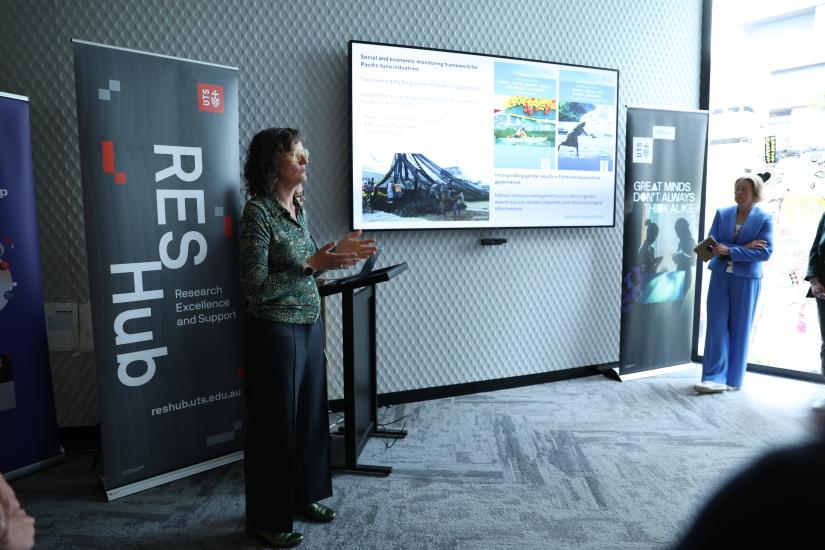
Professor Kate Barclay speaking at Research Cafe
As a professor of sustainability and the environment at UTS, Kate’s research sits at the intersection of social science, fisheries governance and regional development.
With many years of experience working collaboratively across the Pacific and Southeast Asia, she is interested in the social dimensions of fisheries, aquaculture and marine conservation, with a focus on governance and development.
Kate joined us in the Research Café to share practical learnings from research that travels across borders and sectors, including how to design guidance that governments will use and how to build trust in regional partnerships.
Engaging from the start
Kate began by reflecting on a tuna industry project commissioned by Pacific Island governments.
“The governments of Pacific Island countries told us that they wanted to understand how tuna industries contribute to economic development. They commissioned research that addressed a specific set of policy problems they had identified, ensuring its relevance and impact,” she explained.
“We were able to show through our research that tuna fishing is about far more than sustainability. The tuna industry is a source of livelihoods, nutritious food, revenue and national opportunity.”
In other words, Kate said that engagement starts early to identify the problem needing to be solved, the set of questions to ask and how to ensure that the right people are involved.
We were able to show through our research that tuna fishing is about far more than sustainability. The tuna industry is a source of livelihoods, nutritious food, revenue and national opportunity.
In places such as Papua New Guinea and Tonga, engagement at the early stage has been through holding workshops to understand the issues. Later on, it’s been about sharing fieldwork with locals. It has also involved taking early findings back to government partners to consider relevant research questions and the kinds of evidence that would be useful.
“At the outset of a project, we like to hold an inception workshop in country for a few days to introduce our proposed research framework and explore what information people need. It’s important to really understand what people want the outcomes to look like,” Kate said.
A similar collaborative approach is also used to shape the final research outputs.
“Government partners are usually clear about what kinds of evidence they need and how it can best be framed,” Kate said. In Tonga, for example, our research needed to speak to the language of decision-making at the highest level, including by providing evidence of the industry’s economic benefit and its contributions to Gross Domestic Product that could be taken straight to the Prime Minister and Cabinet.”
Identifying the gaps
Because so many fisheries managers are trained in biological science, Kate said that social questions are often treated as secondary concerns.
“The managers tend to think, ‘oh, we’re all about the fish’, and so important issues such as gender equity, inclusion, human rights and compliance can be missed,” she said.
Findings from one research project led to the development of instructional handbooks covering gender equity, social inclusion and human rights in fisheries and aquaculture.
“We found a widespread knowledge gap in these areas, so we designed these resources to help practitioners connect social realities to fisheries outcomes, especially in Pacific contexts where policy decisions and development programs quickly shape everyday life,” Kate explained.
The handbooks were developed through dialogue, revision and shared ownership, with workshops, consultation and repeated testing with target audiences shaping the final products. Careful attention was also given to language, images, case studies and visual presentation.
“We reviewed the drafts line by line with our partners to ensure the material would make sense to Pacific Island practitioners. The result is a pair of handbooks that are practical, accessible and grounded in the realities of the region rather than in abstract theory.”
We found a widespread knowledge gap in these areas, so we designed these resources to help practitioners connect social realities to fisheries outcomes, especially in Pacific contexts where policy decisions and development programs quickly shape everyday life.
Across her career, Kate has seen that the most effective fisheries research does more than generate knowledge. It connects ecosystems to institutions, policy to people and ideas to the realities of implementation.
“Fisheries research is strongest when it is co-designed with the communities and practitioners who will use it, an approach UTS continues to champion through collaborative, impact-focused research,” Kate said. She added that real impact comes from listening carefully, working collaboratively and producing research that decision-makers can act on.
This is an approach for which UTS is well known: partnering with communities and decision-makers to produce research that is both rigorous and relevant.
What’s next?
- Read the handbooks that Kate and her team worked on as part of the United Nations’ Voluntary Guidelines for Securing Sustainable Small-Scale Fisheries in the Context of Food Security and Poverty Eradication.
- Read the Pacific handbook for human rights, gender equity and social inclusion in tuna industries.
- Visit the UTS Climate, Society and Environment Research Centre (C-SERC) website to view current research, including marine social science projects led by Kate.
- Learn more about Kate’s research.
- Join us at the next Research Cafe on 12pm - 1pm 20th May in FEIT (CB11.09.118).